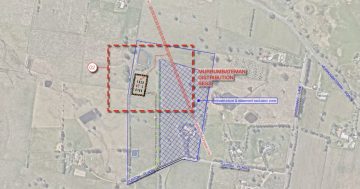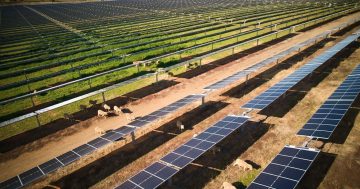


The project is located close to homes in Bilbul. Photos: Oliver Jacques.
A plan to double the number of giant battery boxes at a controversial Bilbul solar farm has been approved by the Land and Environment Court, despite Griffith councillors rejecting the expansion after hearing residents’ concerns.
The ruling allows the number of shipping container-sized battery storage units at 394 Macedone Road to increase from four to eight, with neighbours warning of potential noise, fire risks and falling property values.
“It’s ugly and it’s in the wrong spot. We don’t know what the full impact will be, we’re concerned it will be noisy at night or there could be fire risks,” neighbour Viv Bellato said.
“It’s bad for Griffith.”
But the court did not hold a full hearing to determine whether the residents’ concerns were justified.
Instead, developer Bilbul Renewable Energy Pty Ltd and Griffith City Council reached an agreement during court-supervised negotiations, which was formalised on Tuesday (20 October).
The decision came despite council voting to refuse the expansion in April, after hearing from residents who opposed putting more battery storage close to their homes.
Neighbour Shiron Kirkman expressed disappointment with the outcome.
“As disappointed as we are with the outcome, particularly council’s initial failure to have policies in place to protect residents, and the Western Regional Planning Panel’s failure to give proper weight to residents’ concerns and the use of prime irrigated agricultural land, once complete it’s minimally disruptive for us,” she said.
“However, this should serve as a warning to regional communities. When governments at every level push hard to meet set targets, the average person has little power to change what will happen.
“These companies have little regard for communities, are well funded and connected, receive government grants and subsidies, and can afford legal representation that community objectors or local councils cannot.”

Construction of the solar farms is underway.
Who is behind the project?
Despite its name, Bilbul Renewable Energy Pty Ltd is not a locally owned community energy project.
The company is owned by MPower, which was acquired by Wollemi Energy Group in 2025.
Wollemi Capital describes itself as a climate-focused investment firm. Its team includes Matt Kean, the former NSW Coalition Government energy and environment minister and treasurer who became chair of the federal Climate Change Authority in 2024. He joined Wollemi Capital as director of strategic partnerships and regulatory affairs.
MPower Group CEO Nathan Wise said the company had tried to address local concerns.
“We reached an agreement with Griffith City Council through the court’s conciliation process, and the conditions deal directly with residents’ concerns about noise, fire risk and how close the batteries are to their homes,” he said.
“Residents have been through a long process to get here, and they raised their concerns at every stage. The conditions we agreed with council reflect that. On anything further at this site, we’ll talk to neighbours first.”
The nearest battery unit is about 300 metres from the nearest home and more than 90 metres from the nearest property boundary.
Mr Wise conceded battery inverters do make some noise.
“An independent acoustic assessment found noise at all surrounding homes would be within NSW limits, day and night. The conditions require us to measure actual noise once the site is operating and fix anything that isn’t right, and the noise controls must be maintained for the life of the project,” he said.
“The batteries are certified to the international fire test standard for battery storage, and a 10-metre fire protection zone must be maintained around them.
“The native landscape screening has been widened from 5 to 7 metres on the eastern and western boundaries.
“The additional storage lets more daytime solar energy supply the local network in the evening, when demand is highest.”
The solar panel count will also decrease by 756, leaving 9936 panels.
He said an MPower representative would visit residents near the site to talk through their concerns and the safeguards in place.
Ms Bellato is not convinced, though.
“At the end of the day, the government just pushes ahead with these projects regardless of what locals think,” she said.
“The companies behind them are just out to make a quick buck at our expense.”
The original solar farm and battery project was approved by the NSW Government’s Western Regional Planning Panel in July 2024.
Nearby residents say they were “blindsided” by the approval and were not consulted beforehand. Mr Wise said the project was initiated by another company, Atlas Renewables Pty Ltd, before MPower became involved through a later change in ownership.
Construction is underway and expected to be complete by the end of 2026.