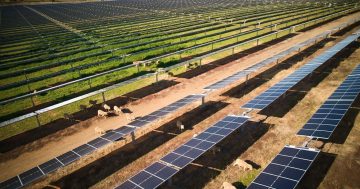
The site of a half-demolished solar farm initiated by the company Vast Renewables Limited in Jemalong has caused headaches for the local council and landholders. Photo: Property Rights Australia/Facebook.
Energy company Spark Renewables has reassured farmers they will not be responsible for cleaning up its Riverina solar and wind projects, after comments by the NSW Premier this week suggested landholders could be left with the task if a company collapses.
Radio host Ben Fordham raised the issue with Premier Chris Minns while discussing a half-demolished solar facility on the outskirts of Jemalong, near Forbes, which has reportedly become an “eyesore” and “fire hazard” since the project manager went into administration in December 2025.
“If the company closes down, then it’s the landholder’s obligation to clean up the site,” Mr Minns said.
“That’s why anyone who negotiates with anyone to use their land needs to have contingencies to remediate the property if there’s damage or the company goes into liquidation.”
The comments alarmed some Riverina farmers concerned about the long-term impact of decommissioning renewable energy projects — both for host landholders and neighbouring properties.
“Nobody wants to be living next to a piled-up bunch of solar panels and wind turbines,” Jerilderie farmer Andrew Sleigh said.
“This is a really significant issue. To those landholders who have agreed to host the infrastructure, we can’t emphasise enough that they need to do the due diligence to ensure they’re not left with the costs.”
Mr Sleigh has previously raised objections to Spark Renewables’ proposed Dinawan Solar Farm, planned for land between Jerilderie and Coleambally and next to his property.
The Malaysian-backed company also operates a solar farm at Bomen, near Wagga, and says responsibility for decommissioning its projects ultimately rests with the company itself.
“Spark Renewables, as the owner of the Dinawan Solar Farm and the Bomen Solar Farm, is responsible for decommissioning of the renewable energy infrastructure and refurbishment of the land at the end of the operational life of these projects. This is a condition included when approval is given to develop the projects,” a company spokeswoman said.
“Spark Renewables owns the land at Bomen Solar Farm and will lease the land at Dinawan Energy Hub. Our lease agreements oblige Spark Renewables to decommission and remove the renewable energy infrastructure and reinstate the land when the project reaches the end of its operational life.”

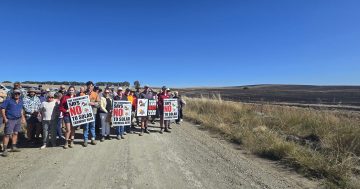
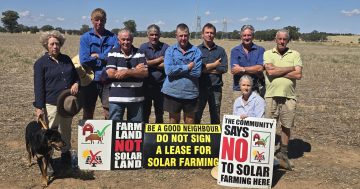
Wagga Wagga farmers have protested against solar farms and the threat they say could be posed to the region’s prime agricultural land. Photo: Shri Gayathirie Rajen.
The Rock farmer Annette Wheaton said she still would not rent her land to renewable energy companies.
“There’s no such thing as a free lunch, which is what has been sold to farmers who decide to lease their land to these companies,” she said.
“A contract is only as good as the paper it’s written on. The project owner company could change several times during the project.
“The multinationals will have more access to legal resources than the farmers if there’s a dispute about who is responsible.”
Ms Wheaton said neighbouring farmers — who have no say in the developments — could also be affected if properties next to large energy sites lost value.
She warned some communities feared they could ultimately be left living beside what amounts to an industrial-scale e-waste site once projects reach the end of their lifespans.
Region asked the NSW Department of Climate Change, Energy, the Environment and Water whether landholders in the state could be left with the bill for cleaning up decommissioned renewable energy projects, but it did not respond.