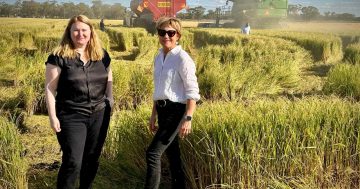
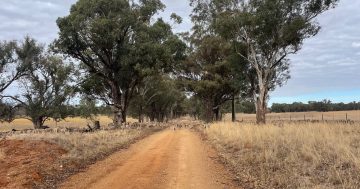
The site of the proposed abattoir near the river has caused concern. Photo: Supplied.
Questions have been raised over why the NSW Government has awarded a $3.9 million taxpayer-funded grant to a proposed Oura abattoir while its approval is being challenged in the Land and Environment Court.
The $3,944,297 grant to Eringoarrah Pty Ltd was announced in July under the NSW Government’s Agriculture Industries Innovation and Growth Program.
The money is intended to help build an $11.5 million on-farm abattoir capable of processing up to 130 head of cattle, sheep and pigs a week, with its own slaughter, meat processing, packaging and cold storage facilities.
The project has been highly controversial in Oura, with neighbours and environmental groups concerned that wastewater from the abattoir could contaminate groundwater, nearby wetlands and, ultimately, the Murrumbidgee River.
The development application was publicly exhibited five times and received dozens of objections over a two-year period before Wagga Wagga City Council approved it in February.
Community group Oura Riverine Protection, which includes neighbouring landholders, then took the decision to the Land and Environment Court, arguing the site is unsuitable because it is so close to the river.
A court conciliation conference was held this week but failed to resolve the dispute, with the matter now heading towards a hearing.
Grong Grong farmer and environmentalist Gemma Purcell says the timing of the grant is inappropriate.
“You would expect the NSW Government wouldn’t give out taxpayers’ money until a project was fully approved,” she said.
“The question must be asked: Why is the government giving any entity taxpayers’ money while that entity is being tested legally?”
Ms Purcell also questioned the merits of giving almost $4 million in public funding to a large corporation constructing an abattoir.
“Is there really no other sensationally innovative agricultural start-up that could have benefited from such a magnificent sum?” she posted on Facebook.
“Abattoirs have been around for centuries, so this one must be bloody innovative to attract this kind of money, prior to legal approval to go ahead with the build.”

Around 30 people attended the conciliation conference. Photo: Supplied.
Region asked Wagga MP Dr Joe McGirr whether he believed it was appropriate for the project to receive almost $4 million while it was subject to a court process.
“On behalf of constituents, I wrote to the minister, requesting details around the assessment and approval processes for the grant,” he said.
“The minister advised that rigorous assessment and due diligence processes were carried out in alignment with the program guidelines and that provisions were in place to protect public funds in circumstances where projects do not proceed.
“I believe that full transparency is required in relation to the expenditure of public money, noting that commercial-in-confidence restrictions can apply in some circumstances, and I understand that details of approved grants are published on the NSW Grants and Funding Finder website.”
Region also asked the NSW Department of Primary Industries and Regional Development why the grant was awarded while the development was before the court, whether the money would have to be repaid if the project could not proceed and how taxpayers would benefit from the $3.9 million.
The department did not directly answer those questions but provided a statement.
“All applications were assessed against the eligibility and assessment criteria published in the Agriculture Industries Innovation Growth Program Guidelines,” a spokesman said.
“An independent probity advisor provided oversight to ensure a robust, fair, and transparent process was followed.
“All successful recipients are required to obtain relevant approvals and meet program conditions before funding and projects proceed.
“No funding will be released without those approvals being secured.”
Five members of the public spoke at a conciliation conference held outside the site of the proposed abattoir, with four objecting to the location.
“You can move the abattoir but can’t move the river,” Peter Lonsdale, owner of The Red Pomegranate, said.
A spokesman for the Oura abattoir proposal was contacted for comment but did not respond. He previously said that given the matter was before the court, his organisation would respect that process and not make any public comment.
The developer has argued the facility would support local agriculture by allowing livestock to be processed closer to where they are raised, while creating jobs and producing locally sourced, grass-fed meat.
The first court hearing on the matter is scheduled for Tuesday 15 September.