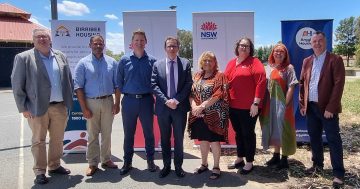
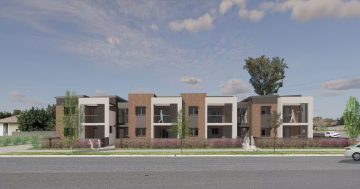
Public housing, like the units at 16 Spring Street, is the only solution to Wagga’s homelessness crisis, says Martin Kennedy. Photo: Chris Roe.
The drama at a recent Wagga Council meeting described by Region this week was distressing for everyone involved.
A packed public gallery advocating for the homeless in their community. A council voting on whether to reverse its own eviction orders. Frontline workers stretched beyond capacity. Government agencies trying to coordinate a response to a crisis that has grown beyond the tools available to them.
Nobody in that council chamber, and nobody in any government office, went into public service wanting this outcome. The people sleeping rough in Wagga did not choose it either.
This situation is the consequence of a housing shortage that has been building for decades, and the only honest thing to say about it is that it is going to keep producing scenes like this until we address the underlying cause.
The blunt reality is that we are not building anywhere near enough social housing to accommodate the number of people who need it.
The scale of the problem is larger than most people realise, partly because the data that shapes our national conversation does not capture it. Only a relatively small share of Australians who meet social housing eligibility criteria choose to apply. Even the number of those in most acute need isn’t known with any real precision.
The Australian Bureau of Statistics estimates the number of homeless Australians once every five years as part of the Census. In between, it’s largely a guessing game, with the best estimates based on the number of people actively seeking help from homelessness support services.
According to Domain, median rents in Wagga have increased by a staggering 55 per cent over the past five years. The gap between what housing costs and what people earn is widening in every part of the country, but it is widening fastest in regional cities.
Home in Place is one of Australia’s largest non-government social housing providers. We see the consequences of this shortage across every community we work in.
Social housing waitlists are at record levels, with even those in critical need out of luck. In Wagga, 674 households are waiting according to Homes NSW, and unfortunately, this regional city is not an outlier.
It is an illustration of something happening across regional Australia, and it’s a direct result of underinvestment in affordable housing over years and years.
The pressure is only going to grow.

Martin Kennedy wants to focus debate on public housing. Photo: Supplied.
Young people are disproportionately represented among those experiencing homelessness but underrepresented in the social housing population. As fewer people enter retirement owning their home, demand for social housing will increase further and waitlists will lengthen.
We are seeing people living in precarious, unsafe situations, and the pipeline of social housing being built is nowhere near sufficient to meet that need.
The private market cannot solve this.
The economics of building homes that low-income Australians can afford don’t work without government, and they never have. What fills the gap is government and community housing providers working together to build, own and maintain suitable housing stock at scale.
This is not a new idea. It is what Australia did for decades, and it worked.
In the 1950s and 1960s, governments on both sides of politics built 15 per cent of all new homes as social or affordable housing. Through the 1970s and 1980s, that figure held steady at around 10 per cent.
Government owned that housing and maintained it. People who could not compete in the private market had somewhere to turn.
When governments walked away from that commitment, waiting lists started to grow, homelessness started to increase and, before long, communities like Wagga found themselves scrambling to manage a structural shortage with crisis funding and motel rooms.
Home in Place is calling on governments to go back to what worked.
At least one in 10 new homes built in Australia need to be social or affordable housing, owned and maintained for the long term.
At the level of ambition Australia maintained for three decades, this is achievable. The answer is not new. We just need to be willing to learn the lessons of our own past.
Wagga’s citizens, councillors, frontline workers and the people they are trying to help deserve better than the position they are in.
So do communities like theirs across the country.
Build the homes. Own them. Maintain them.
That is how we make scenes like this week’s a thing of the past.
Martin Kennedy is Group Executive Manager in Marketing and Public Affairs at social housing provider Home in Place.