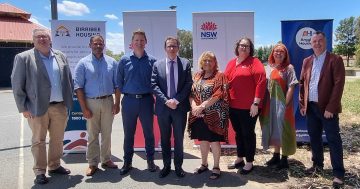
Housing Minister Rose Jackson at the site of the build with Mayor Dallas Tout and Dr Joe McGirr. Photo: Dr Joe McGirr Facebook.
The NSW Housing Minister was in Wagga this week to announce construction had begun on 12 factory-built social homes in Ashmont, but local advocates say the project is only a small step in tackling the city’s worsening homelessness crisis.
The Minns Government is increasingly turning to factory-built or modular housing to boost social housing supply across NSW. Unlike traditional homes built entirely on-site, these homes use components assembled in factories before being transported and installed, allowing construction to happen much faster.
The six dual-occupancy homes in Ashmont will create 12 new social housing dwellings and are expected to be ready for tenants from June. The walls were manufactured in Sydney before being transported to Wagga for assembly.
Wagga has become a focal point of the state’s homelessness crisis following the tragic death of a baby born in a makeshift camp at Wagga Beach, prompting the visit by Housing and Homelessness Minister Rose Jackson.
But community advocates say the announcement falls far short of what is needed.
“We have 12 houses being built but more than 250 homeless people in Wagga,” Wagga Ratepayers Association president Chris Roche said.
“This is a great start but there’s a lot more that needs to be done.”
Mr Roche said it was disappointing that while the minister met with local politicians and officials during an on-site media conference, grassroots advocates working directly with homeless residents were left out.
“Maybe they didn’t have enough hard hats,” Curious Rabbit owner and housing advocate Vickie Burkinshaw joked.

The number of people living in tents in Wagga continues to grow. Photo: Supplied.
Ms Burkinshaw said a growing coalition of residents, service providers and community advocates had begun developing their own ideas to tackle the crisis.
“We have formed a group of people committed to getting research, coming up with ideas and putting forward proposals to all levels of government to find solutions to our housing crisis,” she said.
Ms Burkinshaw and Mr Roche joined not-for-profit organisations, frontline services and people experiencing homelessness at a meeting this week to discuss possible solutions.
“There are a lot of people bringing great ideas and resources,” Ms Burkinshaw said.
“We’ve had people reach out to us who are advocating and wanting to help.
“We had some left-of-field ideas come out that the bureaucrats don’t seem to want to consider.”
One proposal raised involved tapping into trades expertise linked to Wagga’s military presence.
“One idea is utilising tradesmen with the armed services in Wagga. We have bases where they can get tradesmen to support builders,” Ms Burkinshaw said.
“They bring in the armed services for a fire or flood – homelessness is a disaster too.”
Mr Roche said another priority was pushing Homes NSW to repair public housing sitting empty across the city.
“We have houses all around Wagga owned by Homes NSW that are sitting vacant, in places like Ashmont and Kooringal,” he said.
“Some of these houses are in a state of disrepair. Why can’t we get tradesmen in to fix them?
“A coat of paint, reconnecting the power – it can give a house to a family who is living in a tent by the beach.”
The advocacy group plans to take its proposals to independent Wagga MP Dr Joe McGirr in coming weeks.
“We want to work collaboratively with the government and everyone else on this,” Mr Roche said.
“What we have is no longer a crisis, this is a disaster.
“When it’s seen as a disaster, then governments must act.”
If you’d like to help or get involved in finding solutions to Wagga’s homelessness crisis, email Mr Roche at: [email protected]