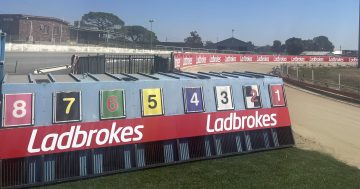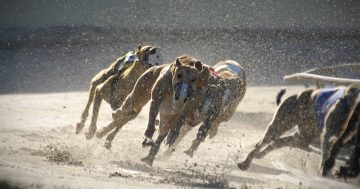


Wagga Wagga Greyhound Club has been operating for 98 years, but has now been informed it will be closing by 2027. Photo: Jarryd Rowley.
Greyhound Racing NSW has confirmed it will cease holding meets in Wagga Wagga from as early as Boxing Day 2026, despite heavy opposition from local greyhound owners and politicians.
The decision to close the Wagga Wagga Greyhound Racing Club comes following an independent report from advisory giant Deloitte, which recommended that the Wagga club, ae well as others including Muswellbrook and Broken Hill, should cease in a bid to optimise the industry’s future.
In the newest update from Greyhound Racing NSW (GRNSW), it announced that the Wagga club would not be closing on June 30 as originally planned but instead in either late 2026 or early 2027 once upgrades to the Temora track are completed.
Greyhound Clubs NSW (GCNSW) president Shayne Stiff said the industry needed optimisation.
“We cannot continue to support the number of clubs we have,” he said.
“We cannot afford as an industry to upgrade every track we have to Minimum Track Standards and one of the recommendations of the Drake Inquiry was that if GRNSW failed to implement a track rationalisation strategy involving the implementation of MTS, then racing should be suspended at all tracks.”
Federal Member for Riverina Michael McCormack has been one of the biggest critics of GRNSW’s proposal to cut track numbers.
Upon learning that Wagga’s closure is now imminent, Mr McCormack said GRNSW had “neglected almost 100 years of racing history for profit margins”.
“In the end, nearly a century of racing counted for nought when those who run greyhounds in NSW disgracefully decided to shut the popular Wagga Wagga club,” he said.
“The club, in the largest inland city in NSW and supposedly the City of Good Sports, has been told it will finish in late December this year or early January 2027 … after, wait for it, the upgrading of the Temora track, which is due in the same time frame.
“Greyhounds race every Friday night at Wagga Wagga Showground with large crowds and full fields (often around 100 runners) at a facility where a lot of money has been spent in recent times and which has people working full-time to ensure its success. Those jobs are now gone.
“The course has upgraded kennelling, track and canteen amenities, but none of that matters, according to those who administer the sport in this state.”
Mr McCormack said the closures were a snub to country people and asked the question as to how the industry could possibly be stronger with fewer clubs.
“The axe has also fallen on Broken Hill, but that’s OK because, as a Sydney-based greyhound official told me, ‘country people like to drive’,” he said.
“These two clubs, I might add, were profitable, pulled crowds, had sponsors and had people whose livelihoods depended on racing.
“This is a shameful cop-out with absolutely no benefit for anyone, save maybe the metropolitan bean-counters for whom bureaucracy and spreadsheets will always win out over salt-of-the-earth country people.
“Rest assured, this fight for the future of the Wagga Wagga dogs is far from over.”