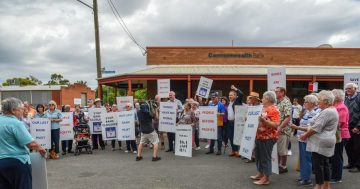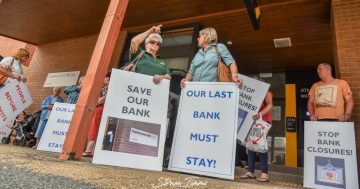

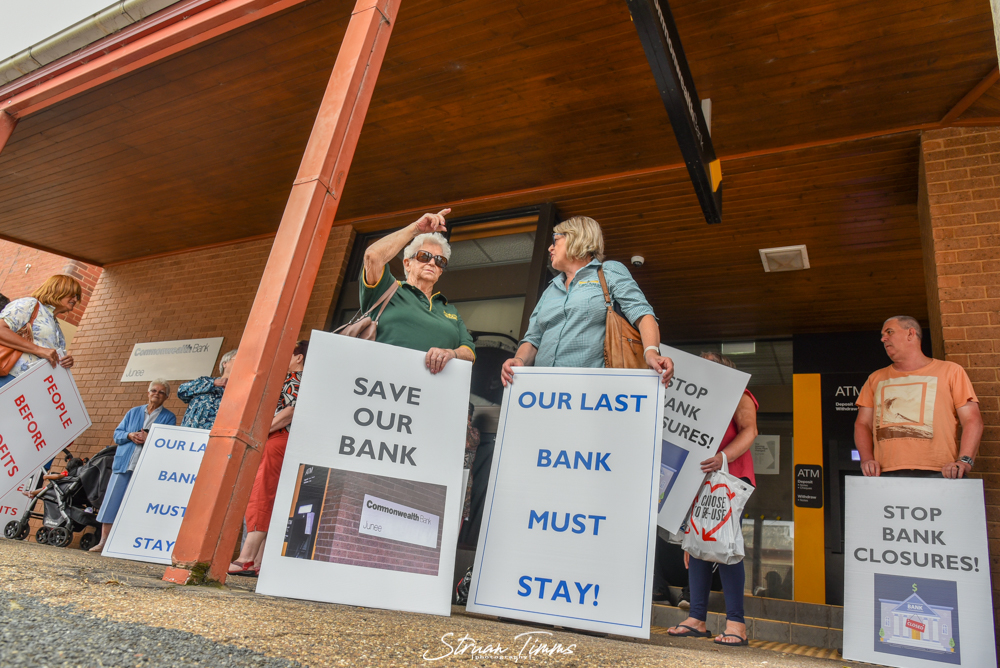
The closure of Junee’s last bank, in 2023, caused many residents to take to the streets in protest. Photo: Struan Timms Photography.
As more and more regional towns are left without banks, Wagga Wagga City Council has voted to pressure the Federal Government to introduce government-run post office banking.
The Notice of Motion introduced by Councillor Richard Foley requested that the Federal Government implement the findings of a Senate inquiry into regional bank closures in 2023/24.
According to researcher Dale Webster, the number of banks in the Riverina has fallen from 78 in 1975 to fewer than 25 now. Since 2020, Junee, Darlington Point, Jerilderie, Ardlethan, Coolamon, Cootamundra, Cowra, Forbes, Grenfell, Harden, Lockhart, Parkes, Temora, Wagga Wagga and West Wyalong have all had at least one bank close.
The inquiry’s recommendations suggested that, to support the elderly, small businesses and farmers in regional areas, a government-operated bank in regional post offices should be provided.
The official recommendation reads: “The committee recommends the Australian Government establish the Regional Community Banking Branch Program (RCBBP).
“The objective of the RCBBP would be to help underwrite the establishment of ‘community bank’ branches providing in-person banking services in regional, rural and remote Australia.
“The committee recommends that the Australian Government work closely with the banks and Australia Post to require all major banks to have agreements with Bank@Post and to harmonise the terms of Bank@Post agreements to improve fairness and sustainability.”
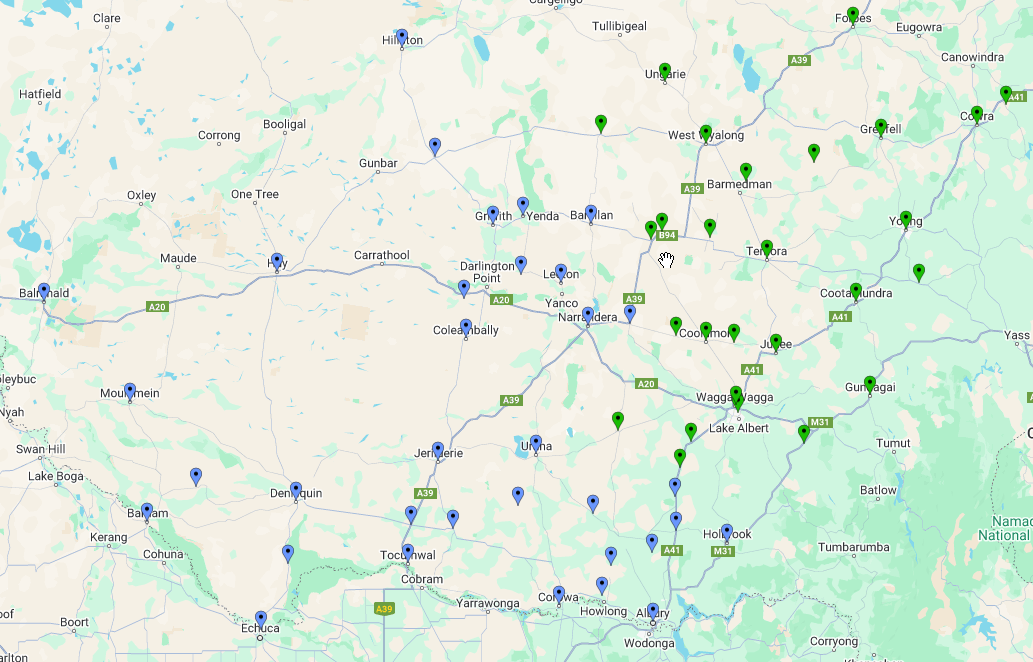
Closed banks in towns around the Riverina. Photo: Dale Webster.
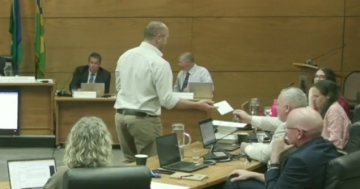
Five of the six present councillors at Monday night’s ordinary Wagga Council meeting voted in favour of writing to Prime Minister Anthony Albanese, Treasurer Jim Chalmers and Minister for Communications Anika Wells to put pressure on them to implement the inquiry’s recommendations.
Crs Tim Koschel (declared conflict of interest), Allana Condron and Amelia Parkins were absent from the vote, with Cr Lindsay Tanner being the only one opposed to the Notice of Motion.
Cr Foley said too many people in regional areas were being left in the dark and shouldn’t be forced to travel hours to do their banking.
“This is a practical matter, and it’s about fairness for regional communities like ours across regional Australia,” he said.
“Access to basic banking and postal services is being steadily stripped away, branch by branch, service by service.
“Decisions are being made in district boardrooms with little regard to the real-world consequences on towns and villages that rely on them.
“Wagga Wagga is not immune to this trend, but particularly the outlying villages and towns are, with the smaller communities that rely on this.”
Australia once had a government bank – the Commonwealth Bank of Australia (CBA) was publicly owned between 1911 and 1991. A discussion paper by progressive think tank Per Capita said the opening of the government-owned CBA “forced the private banks to practically abolish their charges on current accounts … in order to remain competitive”.
The CBA’s privatisation had coincided with bank branches closing across rural areas, the paper observed. Ms Webster estimates two-thirds of all regional branches have shut since banking deregulation began in Australia.
Cr Foley emphasised the importance of regional areas’ access to banking, and highlighted the stresses post offices faced when banks closed.
“Bank closures are not just an inconvenience,” he said.
“They are fundamentally changing people’s lives and the way they do business. Small business needs access to cash, handling deposits, and face-to-face.
“Banking support for older residents, people without digital access, and those who simply prefer to receive in-person services, is being pushed out of the system. When the banks leave, the pressure doesn’t disappear. It shifts, and post offices are forced to pick up the slack.”
Cr Jenny McKinnon supported Cr Foley’s motion in full, saying regional areas were being overlooked when it came to issues such as banking.
“Our rural and regional communities are suffering badly with the situation as it’s developed in the banking services sector, and I would hate to see post offices go that way, where I know many people currently really rely on the post office for their cash transactions,” she said.
“If they are reduced, as is written in the report, that would be a huge concern.”