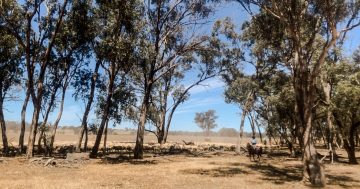
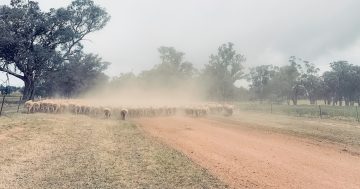
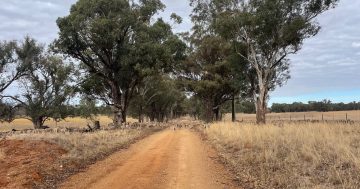
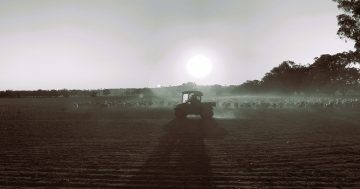
Despite recent patchy rain, water security remains one of the biggest concerns for farmers across the south of the state with on-farm supplies running critically low in some cases. Photo: Edwina Mason.
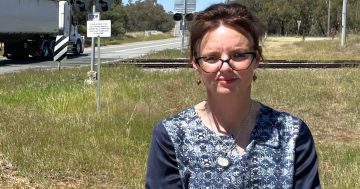
The first decent rain in months has greened up the hills around Greg Greg, but Sarah Farrell isn’t counting her chickens yet.
“It has been enough to freshen everything up and kick the green along, but our dams are still on the empty side,” she said. “It’s not a reset yet.”
That measured response captures the mood across much of southern NSW, where recent rainfall has eased conditions for communities teetering between drought-affected and in-drought status.
For Sarah, the situation is starker.
Her family’s property sits in the Snowy Valleys, about 50 kilometres south of Tumbarumba — and on the NSW drought map, the Upper Murray has been gold for around two years.
It’s not a colour that signals good fortune: gold is the deepest drought classification the state applies.
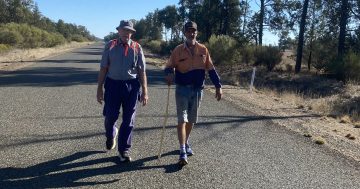
Someone pretty familiar with the map, Ray Willis, has spent recent months driving the back roads of southern and western NSW, meeting farmers, councils, banks and community groups.
Appointed NSW Drought Coordinator in November 2025 for an initial six months, the former Riverina Local Land Services (LLS) general manager has since had his role extended to the end of 2026 and expanded to cover western NSW – and with more than 100 consultations across the region, has become a direct line of intelligence for Agriculture Minister Tara Moriarty.
Sarah was among those who attended a NSW Farmers-organised meeting in Tumbarumba where Mr Willis heard first-hand from producers about conditions on the ground.
She said producers raised a range of concerns: freight subsidies to help move hay from areas with better seasons and access agistment in other parts of the country; loan interest rates they argued bore little resemblance to Reserve Bank rates and fell far short of genuine relief; pest control support and land valuations they considered excessive.
Willis said the concerns reflected what he was hearing right across the board as the state’s drought footprint pulled back from 48 per cent at the end of February to around 40 per cent, with the west shifting from drought into recovery after copping some of the heaviest falls from recent widespread rain.
Some parts of the Upper Murray received between 80 and 100 millimetres in March but with the Bureau of Meteorology (BOM) forecasting below-median rainfall and above-average temperatures across most of NSW through to June, he cautioned that recent falls may prove to be the exception rather than the start of a trend.
“We still need to manage it as if it’s not going to rain again for a while,” he said.
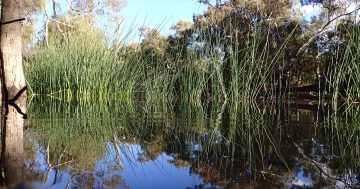
On his travels, water security came up at virtually every stop – on-farm supplies running critically low in some cases, farmers in the far west carting water for stock and, in some instances, for household consumption.
Coupled with that was the constant pressure around the feed-or-destock decision, shaped this season by unusually strong livestock prices.
“That gives them a bit more confidence in making those decisions – being able to bring cash back into the business,” Mr Willis said, “but the next six weeks is fairly crucial for what their next decision is around further reductions of breeding stock.”
On fodder, he said the situation was better than in previous droughts, with most landholders able to source feed locally rather than relying on supplies trucked other states.
The fodder picture was one of the few bright spots in an otherwise grim set of consultations that fed directly into the NSW Government’s expanded drought plan, announced in February.
The plan doubled the available loan under the Drought Ready and Resilient Fund to $500,000, introduced a new $100,000 low-documentation loan requiring no security, and extended $1.8 million to the NSW Rural Financial Counselling Service – a program Mr Willis said producers had been particularly anxious to keep running.
The state measures sit alongside a jointly funded $43.2 million federal Farm Business Resilience Program, delivered through the Australian Government’s Future Drought Fund, which provides subsidised coaching, workshops and business planning support.
In August last year the Federal Government also announced an additional $1 billion in new loan funding to be delivered by the Regional Investment Corporation (RIC).
But Sarah questioned the billing of the new products as low interest.
“The RIC drought product is showing 5.18 per cent variable, up to $2 million over a 10-year term with five years interest only,” she said. “The RAA Drought Ready and Resilient loans are in a similar range – 4.59 per cent per annum for five years or 5.28 per cent per annum for 10 years for loans up to $500,000.
“For farmers coming off prolonged drought, with overdrafts stretched and recovery costs stacking up, that does not feel like real relief.”
Working on the farm’s cash flow this week, Sarah said the 2025 feed bill alone had come to $250,000 – and the bills keep coming; another load of syrup had just been bought for steers and heifers ahead of joining.
“We are completely stretched,” she said.
Mr Willis acknowledged the sentiment was widespread.
“Those that already have existing debt don’t want new debt, and certainly would prefer much lower interest rates.”
Movement on rates was ultimately a matter for NSW Treasury, he said, but he had taken the feedback directly to the minister.
On freight and feed subsidies, he said the door remained firmly closed, following a post-drought review that found limited cost-benefit.
The expanded package set aside $3.2 million for pest animal management, pressure Willis said he had witnessed firsthand on his travels.
“Driving between Wentworth and Balranald, I’m pretty sure I saw more kangaroos, emus and goats than sheep, which is unusual,” he said.
On feral pigs, he said LLS were working hard through aerial shooting, ground baiting and group baiting programs.
Each new pressure added to a cumulative toll that Willis said was showing up in the most serious of ways.
“We know farmers are extremely fatigued – they’re working around the clock to feed and maintain stock and also get their crops in,” he said. “When you’re also isolated and working under extreme conditions it’s a very negative space to be in, and trying to get them off the farm seems impossible,” he said.
He’s working closely with the Rural Adversity Mental Health Program and farm gate counsellors to ensure support is reaching those who need it and pushing to fund community events – drop-in days, barbecues – across the southern region to get farmers off the property and talking to neighbours.
“Sometimes just that one conversation can go a long way,” he said.
Farrell sits on the board of Upper Murray Incorporated (UMI), a community-driven advocacy body straddling the NSW-Victoria border, and knows first-hand how communities at the edges of multiple shires and two state governments can be overlooked.
“That edge of the map issue is what farming can feel like more broadly right now,” she said – a feeling reinforced by a recent visit from Norwegian farmers.
“In Norway, farming sustainability is treated as a strategic national priority, backed by policy that matches what is actually at stake,” she said. “Here it often feels like we are trying to survive inside settings that do not reflect the reality on the ground.”
Mr Willis said the minister was listening.
“Drought is one of her number one concerns – I get to talk to her directly and she is very interested in what I’m hearing on the ground,” he said.
But he pointed to a broader shift in government philosophy – away from reactive in-drought support and toward long-term preparedness.
The aim was for farmers to build enough water and feed reserves to absorb up to two years of dry conditions before needing outside help – through drought plans, tanks, bores, grain storage, and working with local agronomists and LLS staff.
Recovery from a multi-year dry could take five years or more, he said, particularly for those trying to rebuild breeding stock at high prices, and support services would continue well beyond the current drought.
For producers under financial pressure, his message was equally direct.
“Talk to the Rural Financial Counselling Service, talk to DPI, talk to LLS. The bottom line is we’re here to support them,” Mr Willis said.
If you need support:
Mental health
- Rural Adversity Mental Health Program (RAMHP): find your local coordinator at ramhp.com.au
- Rural Aid counselling and mental health support line: 1300 327 624 or [email protected]
- Lifeline: 13 11 14 (24 hours) or text 0477 13 11 14
- Beyond Blue: 1300 22 4636.
Financial counselling
- NSW Rural Financial Counselling Service — Southern and Central region: 1800 319 458
- NSW Rural Assistance Authority (RAA) drought loans: 1800 678 593 or [email protected]
- NSW DroughtHub: drought.nsw.gov.au.
Original Article published by Edwina Mason on About Regional.