

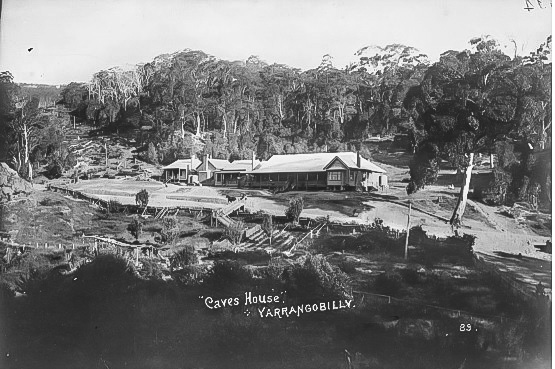
Caves House, Yarrangobilly, circa 1884-1917. Photo: Charles Kerry & Co/Powerhouse Museum.
On Christmas morning in 1895, while most of the Cootamundra district settled into quiet holiday routines, seven young men clipped their feet into the pedals of their bicycles and set off on an adventure few would dare to attempt.
Their destination was the Yarrangobilly Caves, deep in the Snowy Mountains, a journey of almost 300 miles (480 km) on rough bush tracks that tested the limits of both machine and rider.
The trip was later chronicled in the Cootamundra Herald*, capturing a vivid snapshot of a time when exploration relied on a sense of daring.
Exactly how the plan was hatched remains a mystery, but the men assembled from all corners of the South West Slopes — Grenfell perhaps the farthest of them all.
The pioneering party consisted of FT Burrows and Harry Pinkstone from Cootamundra; Tommy Reynolds from Young; Jim Younie from Grenfell; Jack Layton, who was visiting Cootamundra from Goulburn; and Alf Bennett and William Dobbyns from Junee.
The group did not set off together but had arranged to converge at Gundagai.
The Junee lads, Bennett and Dobbyns, joined by Burrows, who had arrived by train, set off via Eurongilly to Gundagai — a stretch of more than 40 miles (64 km).
Reynolds and Younie had arrived in Cootamundra by the morning mail, joining the Cootamundra contingent, Pinkstone and Layton, and set off at 10 am.
But almost immediately, the journey tested their resolve.
Pinkstone’s bicycle failed just outside Cootamundra, and when he borrowed another machine, its crank broke soon after. He would endure half a dozen tube explosions before Coolac, forcing him to abandon the ride and return home by train.
Arrangements had been made for a Christmas dinner for the whole party in Gundagai, but due to these mishaps, the “ceremony” was celebrated instead at Coolac.
Upon reaching Gundagai, it was discovered that the Junee trio had already left for Tumut via Adelong.
Antsy as they were, those riders were soon facing down their own challenges. Delayed by a touch of sun at Adelong Crossing, they suffered further misfortune when Burrows broke a crank descending Gap Hill, forcing him to return to Adelong, where a local blacksmith laboured for hours to repair the bicycle.
In the afternoon, they remounted their machines, aiming to cover the 40 miles to Campbell’s Hotel that night, though Bennett lagged behind.
The remaining three from Cootamundra took the alternative route — the dusty 22-mile (35 km) Marked Tree Road — and reached Tumut by evening, where the group was finally brought back together.
The following afternoon, the cyclists remounted, bound for Campbells Hotel, some 40 miles south. Bennett was left behind.

Talbingo homestead, Tumut, 1903. Photo: Captain HH Share/NLA.
Yet they stopped 17 miles (27 km) short of Campbells Hotel after discovering the hospitable Talbingo homestead, where, according to the Herald, they were warmly entertained overnight by Mrs Lampe and her two daughters, one of whom was almost certainly Stella Maria Sarah Miles Franklin.
Not to be overlooked was the comeback kid Harry Pinkstone, who, two days behind, had secured a new bicycle at Murrumburrah, set off on his own, picked up Alf Bennett at Tumut, and ultimately overtook the main party as they coursed towards Talbingo Mountain.
Six miles (9 km) long, with an elevation gain of roughly 3600 feet (1000 metres), it proved merciless.
Much of it was too steep to ride, forcing the men to push their bicycles inch by inch along the winding track.
Reaching the top brought little respite; the descent was equally dangerous: loose stones, tight bends and sudden drops.
Those whose bicycles had no brakes tied saplings behind their machines to act as makeshift drags.
Just seven miles (11 km) from Yarrangobilly Caves, Reynolds struck a stone, breaking his front axle. It marked the end of his quest — the rest of his travelling completed on horseback and coach — until a new axle was procured at Tumut on the way home.
When the cyclists finally descended on Yarrangobilly the following day, the government accommodation house was surrounded by 64 holidaymakers, many from Cooma, with tents lining the creek.
The sight of riders arriving ‘’on wheels’’ caused a stir; as the Herald noted, no-one had previously attempted the journey to the caves by bicycle.
There were no beers to mark the milestone, as the site was deliberately alcohol-free, in case visitors explored the caves in an “elevated” state, but a festive Christmas dinner was served, followed by a cave tour.
Not content with their efforts, the riders decided they’d visit Kiandra, Australia’s highest town, 15 miles away and mostly uphill, including the four-mile Bullock Hill climb, much of which they walked.
On arrival, they were welcomed by warm fires and beds with blankets, while townspeople, especially children, were thrilled, with one boy yelling frantically for his mother to ‘’Come and see the men riding on nothing!’’
According to later columns in the Cootamundra Herald, the group left Yarrangobilly early on Monday morning, 28 December.
No further accidents befell them, the men perhaps made cautious by a recent incident when a Chinese vegetable hawker, Old Sam, and three companions lost control of a tilted cart down the same slope.
The horse bolted, throwing the passengers, and both cart and driver tumbled down the mountainside.
Though badly bruised, Old Sam survived, tended by Mrs Lampe, while the wrecked cart remained lodged below as a stark reminder of the mountain’s dangers.
The cyclists reached Tumut in time for a swim before tea, stopped at Adelong for dinner the next day, Coolac for tea and returned to Cootamundra by 10:15 pm, except for Burrows, who stayed in Gundagai, and Younie, delayed at Adelong with a touch of sun.
Their Christmas adventure reads today like a ‘’boy’s own’’ tale of muscle, ingenuity, and fortitude — yet one that made history, marking them as the first to cycle into the Yarrangobilly caves country.
*Source: Trove
Original Article published by Edwina Mason on About Regional.