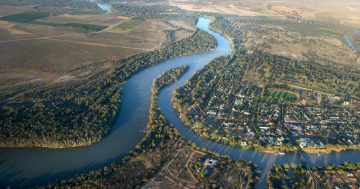
Job losses have occurred at the Leeton SunRice mill. Photo: Leeton Living.
Riverina-based food giant SunRice has announced it will shed 78 staff from its mills in Leeton and Deniliquin, with an industry group and Leeton’s mayor blaming the decision on the Federal Government’s ramping up of buybacks of irrigation water.
After more than a month of consultation with staff and unions, the SunRice Group announced changes to 92 employees across Deniliquin, Leeton and Australian Grain Storage (AGS) operations, with 78 staff to be made redundant, and only 14 to be redeployed.
“The decision reflects recent dry conditions and continuing structural changes to water availability under the Murray-Darling Basin Plan, particularly water buybacks,” Leeton Mayor George Weston said.
A water buyback occurs when the government purchases water rights from irrigators or corporations and transfers that water away from agricultural production and allows it to flow downriver, with the aim of improving river and wetland health under the Murray-Darling Basin Plan.
The federal Labor Government has ramped up efforts to buy back extra water from southern basin farmers over the past year.
While buybacks are made on a voluntary basis, Mayor Weston said they have a devastating flow-on impact on irrigation-dependent towns like Leeton.
“The impacts extend well beyond farmers. They affect our value-adding industries, including rice processing, cotton ginning, citrus juicing and winemaking, as well as the local trades, businesses and government services that depend on a strong regional economy.”
SunRice CEO Paul Serra said it had been a difficult period for his staff, the communities of Deniliquin and Leeton, and the decision to retrench employees was not taken lightly.
“Throughout the consultation process, our focus has been on retaining as many employees as possible, including through redeployment opportunities where feasible, while supporting employees whose roles have been impacted with care, transparency, and respect,” he said.
“We recognise the significance of this outcome for our workforce and the wider Riverina community. SunRice continues to advocate to government on the adverse impacts of water policy settings on the Riverina rice industry, while closely monitoring seasonal conditions and crop outlook.”
Ricegrowers’ Association of Australia (RGA) president Peter Herrmann said the job losses marked a very sad day for the industry but were “not unexpected” given the ongoing “onslaught” of water buybacks under the current government.
“Our industry has survived for more than 75 years. It has endured severe droughts and devastating floods, but the cumulative impact of decades of water reform and ongoing buybacks is now being felt right across our communities,” Mr Herrmann said.
“We commend SunRice for doing everything possible to retain or redeploy staff but the reality of falling production due to less water in the market, increased water prices and more competition mean tough decisions had to be made to keep the rest of the business operational.
“The greatest impact is not being felt on farm. It is being felt by mill workers, transport operators, contractors, and local businesses who have no control over decisions that reduce the water available to support regional production.”
RGA Executive Director Graeme Kruger said the long-term decline in water available to productive agriculture had fundamentally changed the scale of the industry.
“Before significant water recovery, Australia’s rice industry regularly produced more than one million tonnes of rice from over 1000 farms. Since the end of the Millennium Drought, production has struggled to exceed 700,000 tonnes even in wet years.
“Today’s announcement is a stark reminder that water buybacks have real human consequences.”