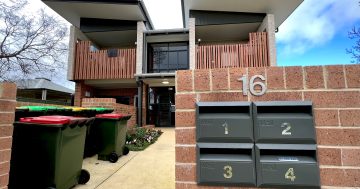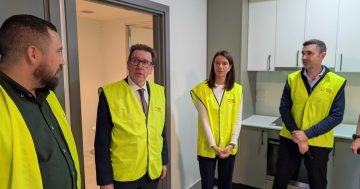


Amy Burns wants to be paid for her work in helping build the 16 Spring Street Homes NSW dwelling. Photo: Supplied.
Tradies who built public housing for the NSW Government on Wagga’s Spring Street will never be paid for their work, with the liquidator confirming there is no money left to repay them as a five-year administration process winds up.
“We’ve effectively been used as slave labour,” said Amy Burns of Oasis Scaffolding and Bricklaying, which is still owed $90,000.
“We bought the materials, did weeks of work and didn’t get paid. Homes NSW are using our asset and renting it out. The government should sell the asset and pay those who are still owed money.”
Homes NSW, then known as the Land and Housing Corporation (LAHC), chose Matrix Group Co as the main contractor to build four public housing units at 16 Spring Street in December 2020 – though it later deleted evidence of this appointment from its website.
A Region investigation revealed Matrix was already insolvent well before Homes NSW appointed it, while public records showed it had also lost its building insurance.
When Matrix officially went into liquidation in October 2021, local subcontractors were left hundreds of thousands of dollars out of pocket.
“Homes NSW has a moral and ethical responsibility to pay us,” Ms Burns said.
“You could see on the internet this company had history of not paying bills. It was not accredited and was not licensed to construct buildings valued more than $20,000. Yet Homes NSW chose them and it ignored subcontractors when we complained about not being paid.”
Homes NSW has consistently refused to compensate the tradies, referring Region to the liquidation process when we asked when they would be paid.
NSW Housing Minister Rose Jackson said in September 2023 she was “devastated” by the situation, with the government seeking legal advice and “actively pursuing the liquidator” for the benefit of all creditors.
But last week, liquidator Shumit Banerjee confirmed to Region the process was winding up and unsecured creditors, including the unpaid subcontractors, would receive nothing because there were no funds available.
Region asked Homes NSW what the legal advice had concluded and what action it had taken to benefit creditors. The department did not answer.
It also refused to say whether it would consider an ex gratia payment or other discretionary compensation, even if it maintained it had no legal liability to pay the tradies.
“We strongly empathise with the subcontractors who are still waiting for payment from Matrix Group,” a spokesperson said.
“Homes NSW only had a contract with Matrix Group as the principal contractor. Homes NSW did not engage these subcontractors, had no contractual relationship with them, and have no legal authority to make payments on behalf of Matrix Group.
“Any action taken by Homes NSW to resolve the Matrix Group’s unpaid debts to its subcontractors would set a dangerous precedent.
“The real issue is not the actions of Homes NSW, but the failure of a private company to pay the businesses and workers it engaged. Homes NSW cannot absorb the liabilities of private companies every time they fail to meet their contractual obligations.”
That position has been challenged by Wagga MP Joe McGirr, who called on the government to intervene in 2023.
“It would appear to me that the government has an ethical, if not actual legal obligation, to act as the guarantor for the payment of the subcontractors affected,” he said at the time.
“I am also concerned that it appears that LAHC should have been aware of solvency concerns earlier and yet still awarded Matrix Group Co the contract for the Spring Street development.”
Region previously revealed Homes NSW failed to identify a public online notice showing Matrix had lost its building insurance. It also failed to identify a public notice indicating the company was in liquidation, with the department continuing its contract with Matrix after both events.
One of Australia’s leading construction debt recovery consultants, Anthony Igra, said he was “baffled” by why the government chose and continued paying an insolvent company to build public housing in Wagga.
“Under the head contract, the government does not have to pay the builder when it goes insolvent. This means the money to pay the subbies is still there, unused. Why can’t this be used to pay the subcontractors?” he asked.
The losses reported by the affected businesses include $90,000 owed to Oasis Scaffolding and Bricklaying, $64,000 to AC Electrics, $55,000 to Plaster Pros Wagga, $42,000 to Wagga Glass and Aluminium, $28,000 to New-Crete Concreting and $54,000 to JMooney Roofing.
For the small businesses involved, the impending finalisation of the liquidation means there is no prospect of recovering those losses through the process Homes NSW has repeatedly referred them to.
The department continues to rent out the homes their work helped build.