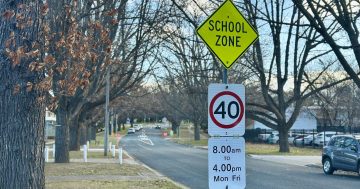


Western Riverina Community School wants a school speed limit zone outside its building. Photo: Western Riverina Community School.
A Griffith school is confused why its students aren’t receiving the same road safety standards as everyone else after the NSW Government refused its requests to install a standard 40 km/h school speed limit zone on the street directly in front of its premises.
Western Riverina Community School caters to more than 35 students in Years 9 to 12 and has been providing its classes at 68 Kookora Street since November 2024. It targets pupils who have struggled with mainstream education.
Principal David Martin asked NSW Government body Transport for NSW (TfNSW) to put a school speed zone outside his school earlier this year. However, the department told him it would not do so.
“There’s no reason not to have a school speed zone outside a school,” Mr Martin said.
“If there were to be an accident involving one of our students, somebody would have a fair issue on their conscience.
“The department told me we can’t get a school zone because our school doesn’t have full-time hours, but I told them that their information wasn’t correct.
“Our students go to school five days a week; we finish a bit earlier but a number of students walk to school next to the road and can be here early or late.”
Region asked Transport for NSW why it wasn’t installing a standard 40 km/h speed limit zone outside the school and whether it assessed the safety risks for students.
“Following initial consideration of a school zone at Griffith’s Western Riverina Community School, Transport for NSW carried out an inspection of the school site on 8 and 9 December 2025,” a spokesperson said.
“The layout of a school zone at this location is complex due to the location of the roundabout within 50 metres of the entrance to the school.
“Kookora Street has an urban default speed limit of 50 km/h.
“Transport will continue to liaise with the school to consider alternate arrangements.”
Mr Martin says he doesn’t understand why his school is treated differently from mainstream Griffith schools, whose students are all protected by school speed zones.
“Many drivers still don’t know there’s a school in this area, which is a concern. A 40 km/h zone would slow down traffic to improve safety for our students, who are as young as 14,” he said.
Transport for NSW previously indicated that Griffith City Council did not support a school speed zone on Kookora Street.
Region asked Griffith Council why this was the case.
“The request for a 40 km/h school zone can only be authorised by Transport for NSW,” Council’s Development & Traffic Coordinator, Greg Balind said.
“Council staff have been able to discuss the proposal with the members of the traffic committee and TfNSW have indicated that there is no support for the school zone to be implemented at this time. There were a number of factors that were considered to reach this position of not supporting the application.
“One issue considered is the speed zone designation requires consistent times to be applied across all of NSW. Part of the submission acknowledged that the Western Riverina Community School (WRCS) operated different times to usual NSW schools. It was also taken into consideration that the students of the community school are expected to on average be aged between 15 to 18 years old, an age group that have a better understanding of road risks. The application also included some roads that are not accessed by the school, and the proposed zone was proposed to commence more than 300 m away from the school; both of these situations are inconsistent with the NSW speed zone principles.
“It should recognise that Kookora Street is a 50 km/h zone and there is some additional infrastructure that the school has yet to implement. It is anticipated that road safety will be improved once the school has completed all of their obligations for the development approval.”
According to its website, Transport for NSW says reduced speed limits in school zones help to protect children on their way to and from school.
“The lower speed limit reduces the risk and potential severity of a crash,” the department says.
Mr Martin hopes his students will one day benefit from what he thought was a blanket policy.