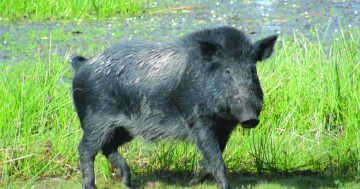
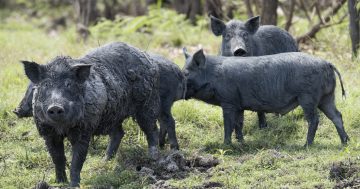
Feral deer are being targeted in the Riverina in the coming months. Photo: National Feral Deer Action Plan.
A major government-coordinated aerial culling campaign targeting feral deer is now underway across western NSW — the first stage of a statewide push that has the Riverina firmly in its sights.
Western Local Land Services (LLS) launched the first phase of a targeted aerial program this week, with shooting across private land in the Hillston-Euabalong area, on the boundary of the Western and Riverina LLS regions, running until 19 May.
NSW National Parks and Wildlife Service (NPWS) will follow with a series of shoots throughout May and June across the adjoining Hunthawang, Nombinnie, Round Hill and Yathong national parks and nature reserves in the Cobar belt to the north.
Together, the two agencies will cover more than 726,000 hectares of mostly flat, open terrain, with about 60 private landholders participating through the NSW Government’s $10 million Good Neighbours Program.
The current shoot is the first tangible delivery of a statewide push foreshadowed last December, when a NSW Department of Primary Industries and Regional Development (NSW DPIRD) spokesperson told The Land that aerial and ground shooting would target deer across multiple regions over the coming 12 months, including the Riverina, Central Tablelands and Western NSW.
Stopping deer spreading westward, the spokesperson said, was one of the objectives of the National Feral Deer Action Plan.
Invasive Species Council (ISC) chief executive Jack Gough said western NSW was precisely where the effort needed to be focused — and the dry conditions made the timing ideal.
“Western NSW is at the front edge of the invasion front for deer,” he said. “Targeting these pockets where the numbers are low, during a dry time, combining national parks and private landholders, that is all standard when it comes to feral animal management. It’s the sort of thing we should be doing a lot more of.”
But he questioned whether the budget was up to the task.
Aviation fuel costs, which typically account for around 10 to 12 per cent of aerial program costs, had blown out to closer to 18 to 20 per cent, with no indication from the government that funding had been adjusted accordingly.
“There’s nothing from them that tells us how much money they’re actually spending,” Mr Gough said.
Fallow deer, the most widespread species in the area, are listed as a priority pest in the NSW Government’s Western LLS Regional Strategic Pest Animal Management Plan.
Mr Gough said the plan was clear that everything west of Orange, where populations remained below 1000, was the zone where eradication was still achievable.
The current operation builds on a model that has already delivered results in the Riverina — though it has struggled to retain dedicated funding.
The Western Riverina Pest Project, initiated after NSW Farmers contacted LLS to coordinate a response to rising pig numbers in the region, targeted the Lachlan and Murrumbidgee river corridors between Hillston and Hay across 1.4 million hectares and 202 holdings.
Between June 2016 and June 2021 it removed 43,608 feral pigs, reducing population density from a peak of 11.2 pigs per square kilometre in 2017 to just 0.88 by 2020, winning the 2021 Froggatt Award, Australia’s peak national recognition for invasive species management.
In 2020, the project expanded to include feral deer and goats, continuing for a further four years before its dedicated funding lapsed.
Mr Gough said the pattern was all too familiar.
“When they start to get the numbers down, what happens is they shift to saying, ‘Well, now it’s just the community’s responsibility to keep it down’,” he said.
“And obviously that doesn’t happen, and then they’ve lost all the infrastructure these programs built.
“No-one cares about invasive species until everyone cares — and by then it’s usually the most expensive time to be doing it because the numbers are out of control.”
The core problem, he continued, was the single-year structure of NSW pest management funding.
The 2025-26 NSW Budget allocated $9.3 million to continue the Feral Pig and Pest Control Program, down from $13.1 million the previous year.
The NSW Natural Resources Commission’s final report, delivered to the government in November 2024, found that funding was too often allocated based on program maintenance or political visibility rather than strategic need — and called for a new, five-yearly Invasive Species Investment Program, stronger enforcement powers and dedicated regional coordinators.
The government accepted the recommendations in principle, but has yet to commit the funding.
Mr Gough also flagged a structural weakness: unlike South Australia, NSW landholders could opt out of eradication programs.
“You’re not wasting your money removing a heap of deer and having a few properties — probably hunting properties — that keep a heap of deer on there, and under NSW legislation there’s basically nothing they can do about that,” he said.
NSW Agriculture Minister Tara Moriarty said the government was taking “decisive, coordinated action” to get ahead of the problem.
She said government-coordinated control operations had removed almost 34,000 feral deer from NSW over the past four years, including more than 15,000 from July 2024 to June 2025.
But the urgency of the issue is underscored by events on NSW’s Southern Tablelands.
In March, authorities confirmed an “extreme biosecurity threat” after hog deer — whose nearest established population is on Victoria’s southeast coast, more than 700 kilometres away — were detected between Blayney and Yass.
The incursion was first picked up through the FeralScan-DeerScan app, prompting biosecurity officers to mobilise immediately to eradicate the populations, with the ISC attributing it to illegal translocation by hunters.
Underpinning these operations is a broader government review of how feral deer and pig management is working across NSW.
Independent Biosecurity Commissioner Dr Katherine Clift has begun assessing current approaches, with her preliminary findings due in June and a final report expected in October.
“The cynic in me thinks that’s why the government has instructed the biosecurity commissioner to undertake a review — with the reporting date pushed off past the budget,” Mr Gough said.
“Any questions, they just answer, ‘We’re taking a review right now’, even though they’ve spent a million dollars on a review of the exact same issue only two years ago.”
The NSW Department of Primary Industries was contacted for comment and indicated it would respond, but did not do so before deadline.
Original Article published by Edwina Mason on About Regional.