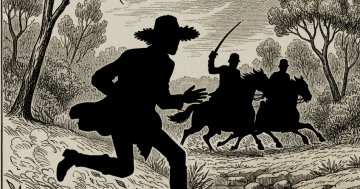
Illustration of Fetherstonhaugh’s encounter with the Bluecap Gang from Smith’s Weekly, 28 May 1927. Photo: National Library of Australia.
In last week’s Rewind we served up a slice of life from 1875 and touched on one of the region’s more colourful characters, Rev. Cuthbert Fetherstonhaugh.
A rebel clergyman, pastoralist and adventurer, the doughty Irishman became a household name in the 19th century and his exploits among squatters, bushrangers and isolated communities cemented his reputation as a hardworking, practical bushman and committed community leader.
Born in Ireland in 1837, Fetherstonhaugh (pronounced feather-ston-haw) arrived on Wiradjuri land in the Riverina in the 1860s when it was on the wild frontier of colonial expansion.
The accomplished horseman and aspiring church minister took charge of the vast Brookong Station near Lockhart in 1866, grazing tens of thousands of sheep across more than 300,000 acres.
According to his memoir, the work undertaken by he and his overseer was extremely heavy and involved riding an average of 12,000 miles a year. He claimed to have survived more than 700 falls from horseback in his life and accrued at least 18 fractures.
Unsurprisingly, the isolated Riverina outpost was a prime target for the bushrangers that plagued the region and in 1867 a band of infamous outlaws paid him a fateful visit.
Robert Cotterell, aka “Bluecap”, was one of the Riverina’s best-known highwayman and had earned his nickname for the distinctive eyeshade he wore to cope with a painful eye condition.
The gang had been terrorising stations and travellers across the Murrumbidgee region and rolled up on the homestead in the early morning and gathered the workers at gunpoint.
“I was not at home when they came, and seeing a mob, on riding up, I thought it was a strike,” recalled Fetherstonhaugh in a Brisbane Courier article from November 1867.
“The first I knew of it was seeing a fellow drop on his knee, and cover me with a rifle, saying, ‘Stand!’ I was only 50 yards from him, and I bolted like a shot, and he let drive, but did not hit me.”
Despite his escape, the dedicated manager decided that he would rather not let them ransack the station unsupervised and calmly rode back to the homestead.
“I thought it best to take them coolly. They were very civil, and did not try any bounce,” he said.
“I told them I’d do all I could to take them, and that I would go straight for the police. They only warned me that if I did they would shoot me if they met me.”
True to his word, Fetherstonhaugh rode for Urana to alert the police, but found the station unattended.
“I tried to get some volunteers, but no-one would come, so I rode away on my own hook, and came on the beggars at a hut on the next station,” he said.
“It was moonlight, and they saw me as soon as I saw them. They gave me seven shots, and followed me three miles, but I gave them the slip.
“I did not fire at them, as I only had a single barrelled pistol.”
While the gallant Irishman brushed over the moonlit chase, the story was immortalised by several writers and poets, including Rolf Boldrewood, the nom de plume of fellow Riverina pastoralist and police magistrate Thomas Alexander Browne.
Boldrewood had also been held up by Bluecap’s gang near Narrandera and the encounter influenced his novels, including The Squatter’s Dream and the iconic Robbery Under Arms.
Bluecap was rendered ‘Redcap’ in fiction and Fetherstonhaugh’s adventures were given to the character Reverend Herbert Heatherstone in The Colonial Reformer.
According to other accounts of the chase, Fetherstonhaugh deliberately lured the outlaws along the banks of the flooding Urangeline Creek causing one of them to be washed away in the deluge.
Police officers joined him the following day and they discovered a drowned horse and the body of gang member Hammond with two revolvers still in his belt.
Fetherstonhaugh continued to play down the tale but finished his correspondence in the Brisbane Courier with a warning for Cottrell and his remaining confederates.
“I am now better prepared, though not well armed, but I never intend to be without a pistol again,” he promised.
“Ever I meet the rascals, I mean to fight them as long as I have a breath.”
Cuthbert Fetherstonhaugh continued to live a life of hard work and adventure, a much-loved preacher who butted heads with church hierarchy, but rode among squatters and bushrangers through Australia’s wild colonial years.