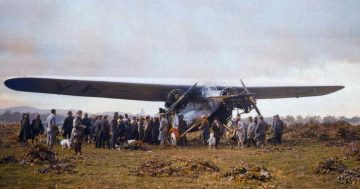
Maurice Guillaux and the Bleriot XI monoplane that he flew in Wagga on 16 May, 1914. Photo: Mitchell Library.
On 16 May, 1914, a crowd of more than 8000 spectators gathered at the Wagga Wagga Showgrounds to get the Riverina’s first glimpse of a flying man.
Famed French aviator Maurice Guillaux, was en route to Melbourne to attempt a record-breaking flight to Sydney and stopped over in Wagga where he unpacked his monoplane to demonstrate the modern miracle of human flight.
“The intrepid French airman, gave above the Showgrounds Wagga, a thrilling exhibition of aeronautics and exemplified to a marvellous degree the extent to which the realms of the air have been subjugated to the will of man,” declared the Coolamon’s Farmer’s Review.
Eleven years earlier in December 1903, American inventors Orville and Wilbur Wright had changed the world with a 12-second controlled, powered and sustained heavier-than-air human flight at the Kill Devil Hills near Kitty Hawk, North Carolina.
In Australia it was the renowned escapologist Harry Houdini who achieved the first official powered airplane flight on 18 March, 1910 when he took to the air in his French-built Voisin biplane at Diggers Rest outside Melbourne.
Other aspiring local aviators followed over the next three years, but few outside of the cities had the chance to witness this modern marvel for themselves.

Maurice Guillaux after winning the Pommery Cup in the Netherlands for the greatest distance travelled in the air in 1913. Photo: Ballonwedstrijden.
Ernest ‘Maurice’ Guillaux was a 31-year-old French airman who had been setting distance records across Europe and dazzling crowds with aerobatics in his Bleriot XI that was nicknamed the ‘Looper’.
Along with a team of four fellow Frenchmen, Guillaux set out on a world tour and arrived in Sydney in early April, 1914.
“He says that his mission in Australia is to prove that aeroplanes are perfectly safe conveyances in the hands of a skilled man,” reported the Singleton Argus.
“Among other things, Guillaux intends to thrill Australians with the “flutter”. “This,” he explained, “is to stop the machine high in the air, and flutter towards the earth like a wounded bird, and about 300 or, 400 yards from the ground, to pick up the machine and either glide upward, or slowly descend.”
The party also intended to attempt Australia’s first air mail and air freight flight from Melbourne to Sydney, taking over the project from American Arthur ‘Wizard’ Stone, who had ruined his plane in a crash in Rockhampton. It would also be the longest air mail flight anywhere in the world.
The flight was scheduled for mid-July and Guillaux loaded his plane onto the train in Sydney on 15 May with the promise to stop for two nights in Wagga.
Coolamon’s Farmer’s Review lamented the decision not to schedule special trains to ferry the crowds in from the surrounding villages to witness the spectacle but described a bustling excitement on the streets of Wagga on the day of the exhibition nonetheless.
“By 3 pm the huge crowd on the showground, and the lesser one congregated outside; were on the tiptoe of expectation,” it reported.
“The Bleriot monoplane, in which the flights were made, occupied a position immediately fronting the grandstand and was the cynosure of all eyes.
“It had a very fragile appearance, and looked for all the world like a huge locust, and by only a cursory glance the most ignorant of aviation would instantly realise that it was only built to fly.”
Guillaux’s arrival at the showground by motorcar was anticlimactic as the moment was drowned out by the town band playing the French anthem. The visiting aviator was deposited behind the grandstand and, unable to find the gate, nimbly scaled the fence and strolled out to inspect his contraption unrecognised.
The crowd soon found its voice and, once kitted out in his woolens, leather and goggles, Guillaux took his seat and his mechanics set the propellor spinning.
The Farmer’s Review declared the first five-minute flight to have been “thrilling throughout”, and described the heart-stopping “flutter” that Guillaux had promised.
“The machine, in one of its evolutions appearing to be falling perpendicularly to earth, with its engine stopped, the wind whistling through it making an eerie sound; many could not help but think that they were to be the spectators of a catastrophe,” it reported.
“Within a hundred feet or so of the ground the engine was again started and the aviator again attained a great height.”
Through two flights in the afternoon, the crowd witnessed “side-slipping”, looping the loop around a dozen times and flying upside down for around five seconds.
“The exhibition was well worthy the patronage afforded it, and it had the effect of making many wonder where the progress of scientific research will ultimately lead us,” concluded the Review.
Two months later in July, Guillaux completed his record-breaking mail run from Melbourne to Sydney, including another brief stop in Wagga and an emergency landing in Harden after flying into a storm on his way to Goulburn.
By August, Australia had entered the war with Germany and Guillaux boarded a ship for France in October, listed as an “aviator” attached to the AIF’s First Division.
While little is known of his time in the Australian military, Maurice Guillaux crashed and died on 21 May 1917 while testing a prototype aircraft at the Villacoublay Air Base in France.