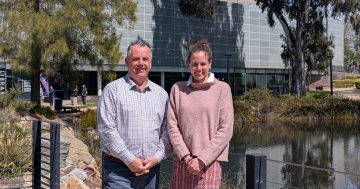
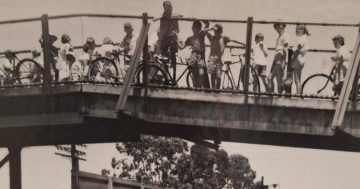
A plaque on the old council chambers commemorates the proclamation of the City of Wagga Wagga in 1946. Photo: Chris Roe.
This Friday the city of Wagga Wagga will officially turn 80 after graduating from the unofficial status of “large country town” on 17 April 1946.
According to Orange’s Central Western Daily, there was “an atmosphere of keen expectancy as the aldermen of Wagga took their customary places at the council chambers. For they knew it was to be no ordinary assembly; that it was to be the most momentous council meeting since 1870, when Wagga was declared a municipality”.
Mayor JV Doyle cleared his throat and a hush fell over the council chambers as he rose to his feet.
“Gentlemen, I have pleasure in declaring open the first meeting of the City Council of Wagga Wagga!” he said, to cheers and self-satisfied applause.
And with that, Wagga Wagga was officially proclaimed to be the 12th city in the state of NSW.
But what exactly did it mean? According to the Murrumbidgee Irrigator (30 April 1946), not much beyond a new ermine trimmed cloak and a cocked hat for the mayor.
“It was officially pointed out that the change will give the council no new power or rights,” it explained.
“The mayor, for example, will not be Lord Mayor, although it is considered probable that the councillors’ decision not to wear robes of office may be reconsidered.”
For the leading citizens of Wagga, it was all about recognition after they had been overlooked due to “an old provision in English law, which grants this title to cities which have an Anglican Cathedral, irrespective of other claims”.

Alderman Doyle wearing Wagga’s new mayoral robes after the municipality was proclaimed a city in April 1946. Photo: Museum of the Riverina / Inset: Chris Roe.
Wagga Council had joined several other regional centres in a campaign to amend the local government act to allow more country towns to become cities.
Under the new rules, a municipality needed to sustain a minimum population of 15,000 and generate £20,000 revenue to qualify. In 1946, Wagga’s average population had exceeded 16,000 for three years in a row and the municipal revenue was more than four times the required amount.
Armidale, Lithgow and Maitland all beat Wagga in the race towards citification but the Murrumbidgee city did manage to get one over its southern NSW rival.
“The mayor of Albury, in sending congratulations to the mayor of Wagga, expressed the hope that it would be Albury’s turn soon,” The Irrigator reported.
Acting prime minister Frank Forde was also quick to offer his congratulations.
“This historic event marks a very important milestone in the progress and development of one of our finest inland cities and certainly one of the richest agricultural and pastoral districts in the Commonwealth of Australia,” he said.
“We have no doubt that Wagga and district have a great future, and we rejoice with yourself and the citizens of Wagga on this great occasion.”
State government officials were also full of praise and the Member for Wagga, Eddie Graham, was thrilled to see his hometown on the rise and penned a glowing tribute.
“To me, as to every other citizen, who for long years, affectionately, and in anticipation of the distinction now officially accorded, has referred to ‘the City of Riverina,’ who has held faith in its future and striven that it might worthily constitute the commercial and cultural centre of a wonderful district with almost unlimited potentialities — the proclamation represents something more than a mere administrative notification,” he declared.
“It represents a spur to further and sustained endeavor; to the maintenance of a spirit of civic pride; to organisation working on a definite plan for the advancement both of the city and the great Murrumbidgee Valley from which, in the first place, its every man and woman derived their means of sustenance and the amenities and utilitarian services which they now enjoy.”