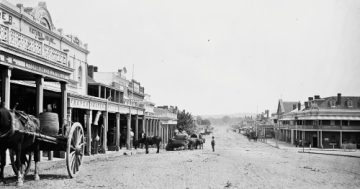
A protest over high rents in Wagga in the early 20th Century. Photo: WWDHS.
“The shortage of houses is becoming a vital question in Wagga,” reads the opening line from an Albury Banner and Wodonga Express article from October 1918.
“For every house vacant there are 30 or 40 applicants, landlords being able to pick tenants and fix any rents.
“The only remedy was building more houses.”
It’s remarkable how often the news from years ago can mirror the concerns of the present!
As residents across the state are feeling the squeeze in 2026, our historical counterparts of more than a century ago were also warning of an impending housing crisis.
In 1910, Wagga Wagga had a growing population of around 6000 souls and a booming agricultural economy, but it seemed there was one thing holding them back.

Looking over Wagga from Willans Hill, 1911. Photo: Wagga Wagga & District Historical Society.
An editorial published in the Wagga Wagga Advertiser on 23 July 1910 under the headline “Homeless in Wagga” triggered a wave of letters to the editor as locals vented their fury over the lack of dwellings available to newcomers and the high costs and poor returns for investors.
The story declared it an “opportunity for the speculative builder” and argued that locals who had grown wealthy from the region’s bounty should invest in the future of the community.
“The only reason is that in the municipality, which boasts of its progressiveness, of its rapidly increasing population, and of its great possibilities, there is no one sufficiently enterprising to put up a few moderately sized dwelling houses as a speculative venture,” the writer complained and suggested that the rising cost of materials and labour should be weighed against the enormous demand.
“The argument against the speculation, we know, is that the cost of building is too heavy for any one to undertake the erection of houses of this class, but there is little need to fear the successful results of such a venture when we see in Wagga the class of dwelling, many of them scarcely worthy of the name, for which a weekly rental of eleven and twelve shillings is paid.
“For a man with money there could hardly be a better speculation.”
Among the flood of responses, a letter from 6 August 1910 offered a collection of opinions from “local men”.
One local builder argued that he could not afford to put his own money up as a house that cost £400 to build would only return £1 per week without accounting for tax, land prices and difficult tenants.
A local house agent weighed in with the news that he had a bunch of great properties priced “well within the reach of the means of the average working man”. For a £10 deposit you could kick out the renters, move in, and have the full cost of £250 paid off in around nine years.
A landlord warned that council demands, upcoming sewage works and the expense of installing the newfangled flush dunnies would undermine any return on investments unless rents were raised.
Another correspondent admitted that the opinion piece had “some justification” but lamented that the municipal building codes were too upmarket and prohibitive.
“I think for a town like Wagga, which today is, and tomorrow might be carried away with a flood, it is altogether too much influenced by classical ambition,” he warned.
Several others suggested that a building society would be the solution and it was rumoured that a fund in Beechworth was paying attention and that a not-for-profit Starr-Bowkett Society would soon kick off in Wagga.
Unfortunately, as we know all too well, there was no easy solution and the municipal council appointed a special subcommittee to “enquire into the causes of the shortage of dwelling houses in Wagga”.
In August 1911, The Daily Advertiser reported that local builders and architects fronted the committee to make their case and propose solutions.
There was a push for more semi-detached dwellings that triggered an argument over their proposed distance of 15 feet from the street. They debated the current regulated 9 inch thickness of walls with one builder declaring it a “false economy” and insisting that 4.5 inches was fine. Another builder challenged the ban on building wooden shops on Baylis Street and they also discussed the idea of doing away with back lanes in favour of a side vehicle entrance.
“None however suggested a solution to the problem,” concluded the report.