A crowd of around 10,000 gathered near Wagga Beach in February 1931 to hear Charles Hardy call for a new Riverina State. Photo: National Library of Australia.
In the wake of One Nation’s recent victory in the Farrer by-election, we’re winding back the clock to the 1930s and another right-wing populist surge that tried to sever ties with “communists” and city dwellers.
The Riverina Movement emerged in the 1920s, inspired by earlier attempts to create new Australian states and the belief that decentralisation would allow regional communities to govern themselves more effectively.
During the economic turmoil of the Great Depression farmers were suffering from falling wheat and wool prices, drought, unemployment and heavy government regulation and felt ignored by city-based governments.
Advocates argued that the Riverina’s economy, geography and identity were distinct from the coastal metropolitan populations of Sydney and Melbourne and proposed an inland state centred around Wagga Wagga, Griffith, Leeton and Albury.
On 28 February 1931 an enormous gathering of around 10,000 supporters met beside the Murrumbidgee River in Wagga where the beach is located today. The Age reported that men had travelled from across the region and Wagga businesses closed their doors between 1 pm and 3:30 pm to allow everyone to attend.
A young Riverina farmer named Charles Hardy emerged as the public face of the campaign and told the crowd that they were fed up with paying for Sydney’s underground railways and harbour bridges.
He declared that if the government did not address their concerns within the next 30 days, “immediate steps be taken to hold a referendum on the question of the right of the Riverina to determine its own affairs and control its own destiny as free people under the British Crown; if necessary, by secession with its consequent refusal to pay taxation to the existing governments”.
Hardy was highly critical of Premier Jack Lang’s NSW Labor government but said that it was “all party politics” that he was opposed to.
The media of the day loved the charismatic young speaker and newspaper mogul Frank Packer dubbed him the “Cromwell of the Riverina”. One reporter from the Sun was clearly smitten and offered his readers a particularly soulful introduction.
“Quiet brown eyes look at you. Calm, discriminating eyes they are, and they weigh you up with care,” the reporter gushed.
“A tall, broad-shouldered man, good-looking in a virile, masculine way, in the full flush of the vitality of the early 30s, rises to greet you. Firm, determined, he breaks into a pleasant smile.”
In an interview with The Gundagai Times in April 1931, Hardy warned that the Labor Party was steering the nation towards communism.
“The reaction is seen in the storm of protest that is sweeping the country districts,” he said.
“Compulsory unionism, repudiation and now socialisation of industry all present a weary vista even to the worker who sees security of employment and reasonable remuneration vanishing like a fog under a ray of sun.”
As he continued on his mission to overthrow the Sydney elites and “stamp out the curse of Sovietism” Hardy was compared to nationalist Italian leader Benito Mussolini who had led the charge against workers unions and “Bolsheviks” in his own country.
“We of the Riverina movement have been accused of being fascists,” he told a meeting in Queanbeyan in July 1931.
“But we do not object to that because the basic principles of fascism are the rights of the individual, love of God and love of country.”
Hardy was elected to the Senate at the 1931 federal election on a Country Party ticket and the following year six members of the Riverina Movement were elected to NSW Parliament.
The movement continued to attract supporters during the years of the Depression, however divisions soon emerged between the radicals who wanted immediate separation and moderates who preferred constitutional reform.
As economic conditions began to improve, public urgency for drastic change faded and in 1939 a second war with Germany had overshadowed domestic political concerns.
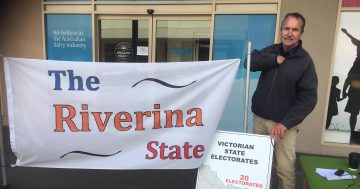
While mostly forgotten, the calls for new Australian states occasionally resurface in political debate and in recent years the REXIT movement has continued to fly the flag for the creation of a Riverina State.
As for the charismatic Country Party Senator Charles Hardy, he was not reelected in 1937 and took a role as co-ordinator of works with the Royal Australian Air Force.
On 27 August 1941 Hardy and two others were killed in a plane crash in Far North Queensland. He was just 42 years old.