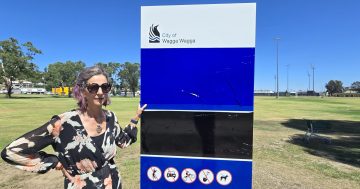


Wagga councillor Jenny McKinnon will continue to push for the removal of synthetic grass pitches in Wagga, citing concerns around the heat they generate and environmental issues. Photo: Jarryd Rowley.
Wagga councillor Jenny McKinnon has expressed that she will continue her push for Wagga to remove synthetic grass pitches from its sporting grounds.
Cr McKinnon launched a notice of motion to Wagga Wagga City Council in 2022 to look into the possible harm fake grass from sporting grounds can cause, stemming from high pitch temperatures during summer and the forever chemicals used to create them.
The NoM came following the launch of a report into the dangers of synthetic grass by the then NSW Minister for Planning and Public Spaces, Rob Stokes in November 2021.
Cr McKinnon said WWCC now had the chance to get on the front foot.
“While the final report is yet to be finalised, the preliminary report asked councils to consider stopping approvals for synthetic turf on our public sporting fields because of the risks to children through heat and injury as well as the problems too for the environment, but it was voted down on the basis that council should wait for that final report to come from the chief scientist,” Ms McKinnon said.
“I just feel that we just can’t keep on waiting for this.
“The evidence is there about what the problems are. And in my view, you know, there are plenty of councils who’ve already made decisions about this, and have stopped the use of synthetic turf on their public fields around NSW, but Wagga, unfortunately, is not one of them.”
The two sports that primarily use synthetic turf in Wagga are field hockey and cricket.
Cr McKinnon said she was aware of Wagga Hockey’s desire to keep the synthetic fields and the benefits they provided to cricket, but that both should reconsider their positions.
“I’m not saying it happens overnight. I think there’s probably got to be a transition that happens,” she said.
“The traditional cricket pitch is a grass surface, and so going back to natural grass is far cooler and far safer in terms of, you know, the environmental dangers that it represents.”
Chairman of Cricket Wagga Wagga George Burley expressed his opposition to phasing out synthetic pitches, believing more context needed to be provided when talking about the size and use of synthetic grass.
“If they were to be removed right now, it would be detrimental to cricket regionally,” he said.
“The primary report looks at full fields in Sydney that use this synthetic turf, but here in Wagga, we’re only using strips for cricket pitches in the middle of ovals.
“We understand the best thing for cricket is to have actual grass pitches, but it’s next to impossible to find curators, and the one ground that is curated by council, their current curator is actually moving on, so there’s a possibility we might not even get that.”
Mr Burnley said Cricket Wagga was always looking to alternatives, but it would be a lengthy process to find a suitable replacement.
“There are more and more hybrid options coming into play,” he said.
“For cricket, there’s sort of like a honeycomb rubber mat that can be placed down with turf and the clay placed in between. That’s supposedly able to take more wear and require less curating each week.
“Cricket Wagga is actually in discussions with Cricket NSW and Cricket Australia to trial some of those pitches here.
“We actually are trying different things in this space. We’re open to trial ideas, but to remove synthetic pitches and offer no alternative would be detrimental to the association.”