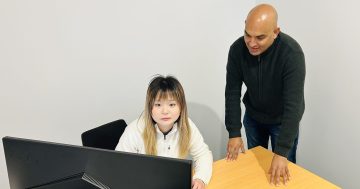
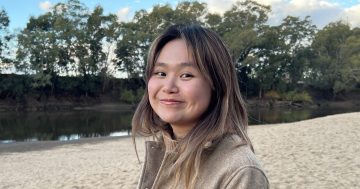
It was a particular thrill for Region Riverina editor Oliver Jacques (right) to meet investigative reporting great Chris Masters. Photos: Supplied.
Proving that big-impact journalism isn’t restricted to city newsrooms, Oliver Jacques has been chosen as the only regional journalist for a prestigious investigative fellowship.
The Region Riverina editor was among just seven journalists selected for the Walkey Foundation’s Masters & McKenzie Investigative Journalism Fellowship.
Jacques travelled from Griffith to Sydney to take part in a two-day workshop with some of the best investigative journalists in the world, including Chris Masters, Nick McKenzie and Kate McClymont.
“I was on the edge of my seat the entire time — what these guys do is both exhilarating and terrifying,” Jacques said.
“It’s so rewarding to bring injustice to light, but there’s also a great personal cost: death threats and never-ending court battles defending yourself seem to be part of the job.
“They have sacrificed a lot to make Australia a better and safer place.”
Senior reporters from The Sydney Morning Herald, ABC and SBS filled the six other spots.
The participants were ushered into a tech-free room so the investigative journalists could speak about the tricks of the trade, including how they had broken some of their biggest stories.
“Kate McClymont told us she responds to every single email she receives, and she gets hundreds every day,” Jacques said.
“Young journalists these days tend to email all the time, but we heard you get much better responses on the phone, and even better in person.”
Masters spoke about how the importance of human connection helped him break the story that French secret service agents were behind the 1985 sinking of the Greenpeace ship the Rainbow Warrior.
“He told us, when he was questioning a French agent, that by the way his eyes moved, [Chris] could tell [the agent was lying],” Jacques said.
“It’s something he never would have found out if it had been a phone interview.”

Gold Walkley winners Chris Masters and Nick McKenzie (front) with fellowship participants Oliver Jacques, Olivia Jenkins, Alex Turner Cohen, Max Maddison, Niv Sadrolodabaee, Amber Schultz and Michelle Elias.
Jacques said it was an honour to be selected to attend, and he was particularly pleased to hear the presenters stress the importance and value of regional journalism.
“Some people might see regional journalism as a stepping stone to a career in the big cities, but the general view at the fellowship was that some of the best stories come from small towns, and you learn skills there that you simply can’t get in metropolitan areas,” he said.
“In Sydney and Melbourne, stories are often handed to you, but in places like Wagga and Griffith, you have to go out and find them.”
Jacques believed it was the great work being done at Region Riverina that earned his fellowship selection, including his investigation into a Griffith winery that owed the tax office $32 million.
That story was a finalist for a Walkley Award.
“Chris Masters also told me he liked my coverage of the Farrer by-election,” Jacques said.
“I was shocked that he even knew who I was. That was a real thrill.”
Investigative journalism involves a great deal of grunt work and behind-the-scenes preparation, so readers shouldn’t expect breaking stories in the short term.
But Jacques believed the experience would show regardless.
“It will improve the quality of all the work I do, not just investigative stuff,” he said.
The selected journalists also heard from Marian Wilkinson, Charlotte Grieve, Bruce Belsham, Kirsty Thomson and lawyers Kiah Officer (ABC General Counsel) and John-Paul Cashen (Thomsons) during the two-day event. Monica Attard chaired the full weekend’s program.
The fellowship will be offered again next year.
“I’d encourage anyone interested in investigative journalism to apply,” Jacques said.
Original Article published by Claire Fenwicke on Region Canberra.