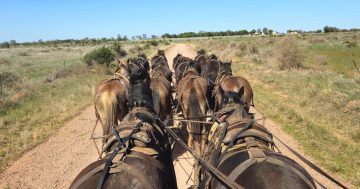
Little Teamster Trophy winner Charlie Woodhouse, from Queensland driving a British alpine goat called Glen, assisted by Jody Batchelor. Photo: Barellan Good Old Days Festival.
A goat destined to be “goat curry” helped one of the nation’s youngest cameleers take the win in the Little Teamsters Award at the 2026 Barellan Good Old Days Festival.
It was nine-year-old Charlie Woodhouse who caught the judges’ eyes over the October long weekend festival, driving a miniature sulky with her trusty accomplice Glen the goat.
Glen – a British Alpine goat – is owned by Jess Green and had been originally rescued from the pound by a friend.
“He was destined for goat curry but here he is and he has won the trophy – it’s fantastic,” Jess said.
It was a case of all creatures great – and small – at the hugely popular three-day festival that is now the biggest tourism event in the Narrandera Shire.
The Good Old Days Festival honours the legacy of an Australia built on the backs and strength of working animals and the people who now keep those skills alive.
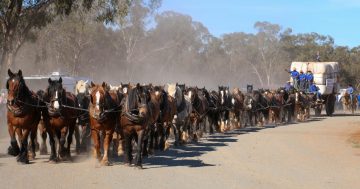
From 2 – 4 October, it again featured Australia’s largest gathering of harnessed draught animals – from Clydesdales, Australian Draughts, and donkeys to bullocks, camels, mules and goats who converge on the local showground in a spectacle organisers claim is unmatched anywhere in the world.
A family affair
For the likes of young Charlie – who hails from Boulia in Queensland – the spirit of preserving these traditional skills runs deep in her blood. Charlie’s mum, Kyrraley, said her daughter has been driving for the past three years, starting out on camels with her cameleer father, Tom Woodhouse.
Tom was part of another Australian record-making team at Barellan this year. He joined fellow cameleers Rodney Sansom, Peter Hodge, and offsiders Peter and Ken Towle to set a breath-taking new record of 32 camels harnessed three abreast to a wool wagon, eclipsing the previous record of 22 set at the 2024 festival.
The massive team padded majestically around the showgrounds, steered by Peter using three sets of reins and led by front-runners Thirsty and Bubba.


Thirsty, a racing camel, is best known for his antics of drinking straight out of water bottles.
“You need characters in a team to make the team,” Rodney said. “We have brought together heaps of leaders and followers, and gradually thrashed it out to make a full team.”
International attention
Rodney first approached Peter to talk about the record attempt 12 months ago, before roping in camel racing mate Tom and horseman Bernie Rice – the latter better known for his team of eight Section A Welsh ponies and miniature Cobb & Co coach.
Bernie and his wife Heather trained and contributed two camels to the big team, which was fine-tuned on the stock routes around Barellan in the lead-up to the event.
The record attempt even attracted nine international visitors from the US, including representatives from the Texas Camel Corps and the North American Camel Ranch Owners Association.
The group of camel owners and enthusiasts jumped at the chance to experience the thrill of riding on the biggest harnessed camel teams in modern history.
“We had the visitors stop a team of 14 camels using just voice commands, and they couldn’t believe they could yell out and stop them,” Rodney said.
“Australia is unique in the world for harnessing camels to wagons. We have been aiming at this for years, and it’s all folded together at the right time.”
Bullocks circle into record books
Meanwhile, five of the world’s greatest living bullock drivers combined their expertise to produce another stunning spectacle, setting a new record of their own.
Yoked in pairs, a team of 56 bullocks pulled a historic, Australian-built wagon to set a new 21st-century record on 3 October.
While experts say the all-time national record of 102 — set at Cessnock in the 1980s when the timber industry was at its peak — is unlikely to ever be bettered, this modern feat left the crowd in awe.
Bullock driver Phil Thomson said the composite team comprised dairy, beef, and crossbred bullocks.
The leaders, Willy and Robin, were 10-year-old Illawarra Shorthorns bought out of the Warwick saleyards, and were also once destined for slaughter.
The huge team responded seamlessly to voice commands from the bullockies, putting on a spectacular display by wheeling into a massive circle where the leaders almost caught the polers at the back.
Phil, who has travelled the world researching the origins of draft animal power, noted how special the local heritage is.
“Australia’s teams have evolved to be efficient for our needs, and our industry is quite extensive compared to Europe where pairs of cows are used,” he said.
“The only reason bullocks have survived here is because of the timber industry, and the gear is made for a one-man operation. The gear was so simple compared to what a draught horse required.
“For a bullock team to be successful nowadays,” Phil added, “you have to have a passion and a purpose.”
For more highlights from the Barellan festival visit the Barellan Working Clydesdales Facebook page.