

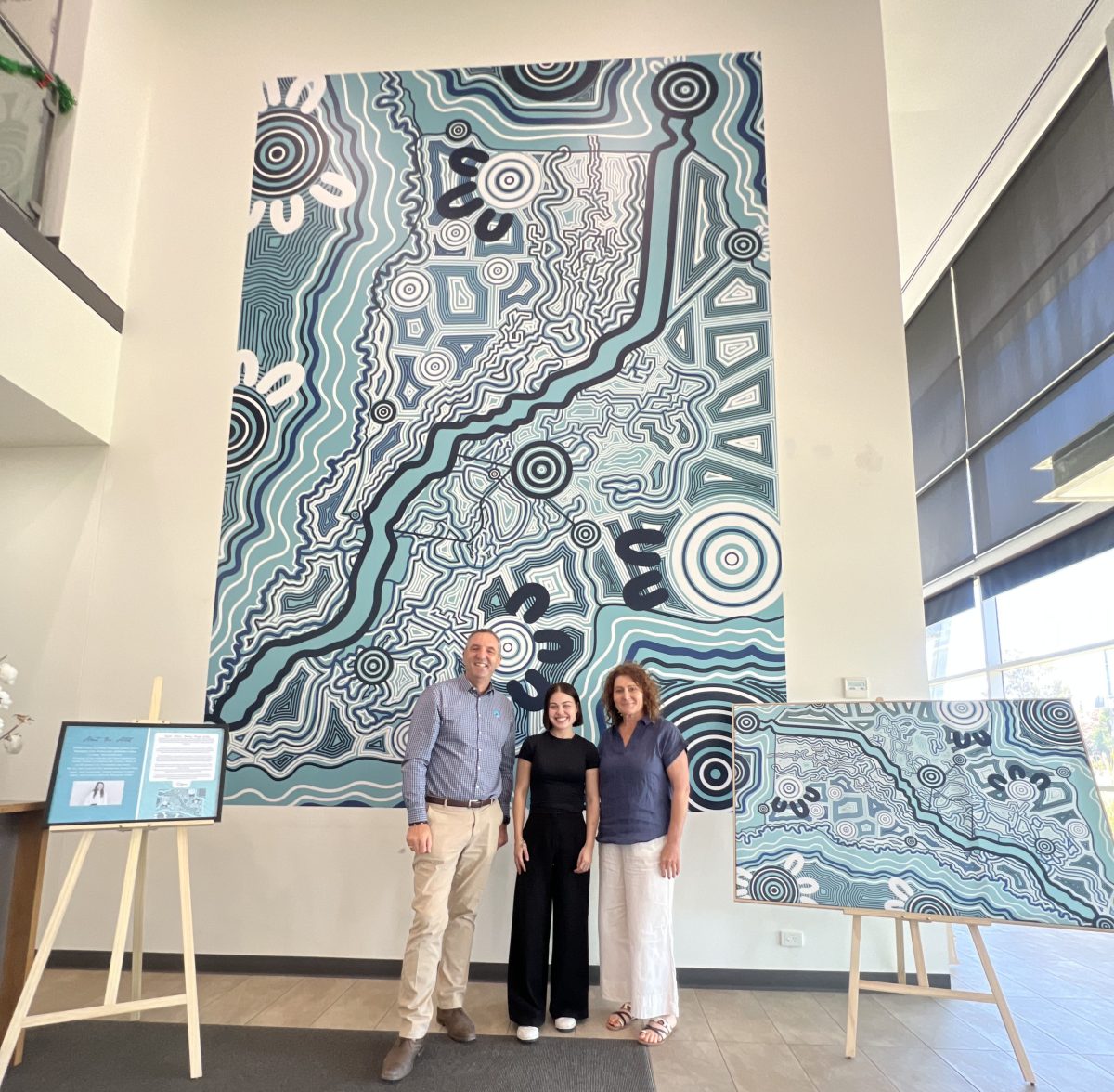
MI CEO Philip Holliday, artist Shelby Lyons, and MI Chair Tracey Valenzisi. Photo: Supplied.
Water supply company Murrumbidgee Irrigation (MI) unveiled Indigenous artwork at its Hanwood office this week which it says symbolises its values of honesty, openness and improvement.
Earlier this year, MI commissioned Wagga-based Wiradjuri artist Shelby-Rae Lyons to create a piece that reflected the essence of the MI system as it winds through Wiradjuri Country.
Her design combines traditional Aboriginal knowledge systems with modern irrigation infrastructure, weaving a story of water, Country, culture, and connection.
“At the heart of the piece flows the Murrumbidgee River, in rich shades of blue, symbolising its strength as the spiritual and physical lifeline of the land,” Shelby-Rae said.
“From the Murrumbidgee River, fine linework extends outwards, representing the channels and irrigation systems that now feed the Murrumbidgee Irrigation Area, a modern network layered over ancient Country.”
Ms Lyons, who grew up in Narrandera and Griffith but lives in Wagga, is one of the Riverina’s most well-known artists. She previously designed a giant Murray Cod sculpture that was displayed at Pioneer Park Museum.
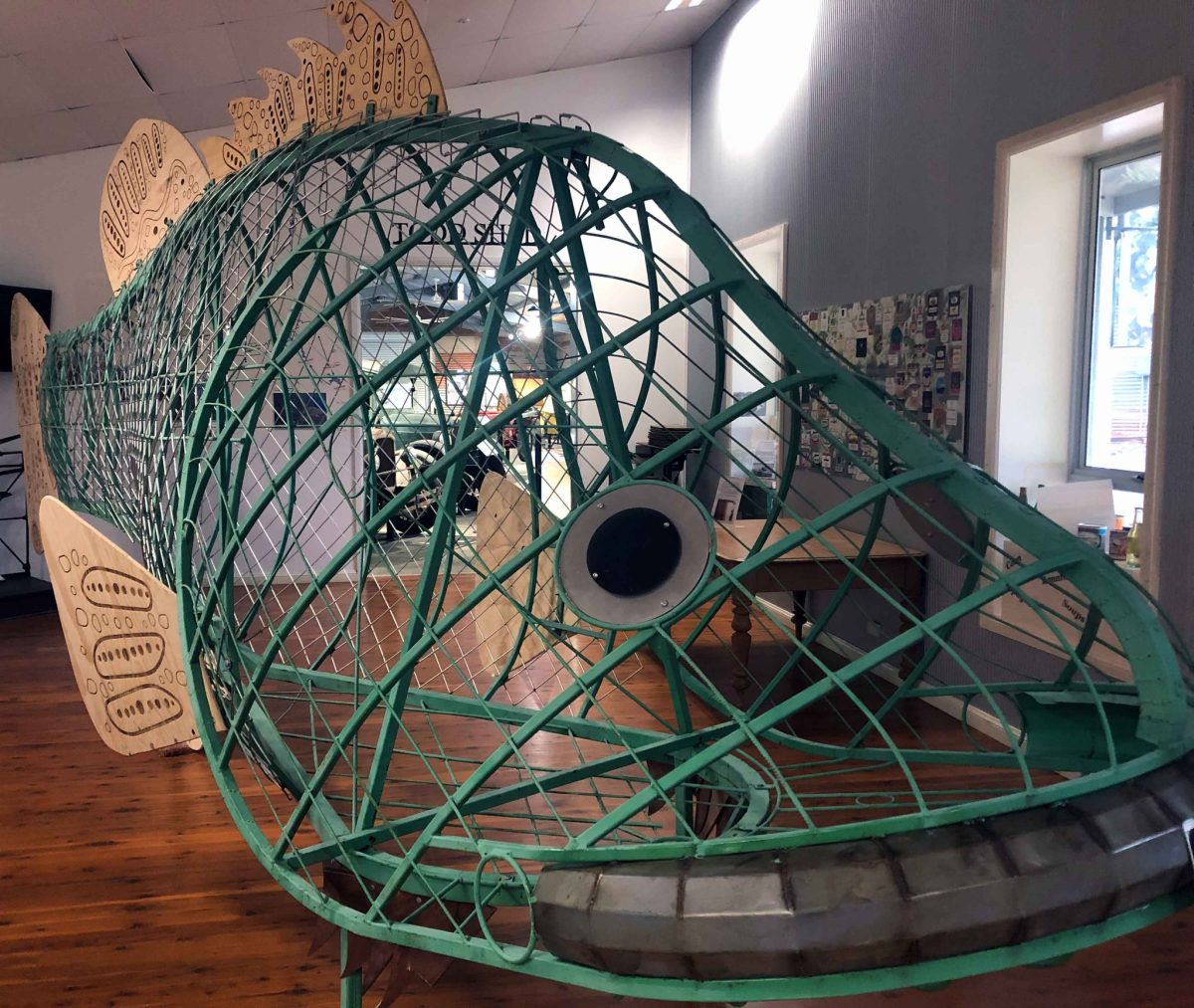
The impressive Murray Cod sculpture Ms Lyons did with her cousin Peter Ingram. Photo: Pioneer Park Museum.
The 29-year-old sells Wiradjuri-themed bags, gifts, hats, prints and other items she makes through her own business, Marara Designs.
She explained how her artwork at MI encapsulated so much of the Riverina.
“Surrounding towns and communities, including Gunbar, Narrandera, Leeton, and Griffith, are marked as meeting places, shown as circular symbols that represent these towns where people gather. These symbols reflect both current towns and traditional campsites, showing how past and present intersect across Wiradjuri Country,” she said.
“A main travelling line traces the journey from Gunbar to Narrandera, winding across the artwork in white and green hues, symbolising the modern pathway of people, trade, and cultural exchange.
“Surrounding the main traveling line and Irrigation Way are paths that echo the songlines, trade routes, and footprints of the Wiradjuri People, who moved with the seasons and the flow of the rivers.
“Throughout the piece, dot work and linework highlight the abundance of food sources, campsites, and places of cultural practice, acknowledging the deep, spiritual and physical relationship that traditional owners, the Wiradjuri people, have with the land and its waterways.”
MI CEO Philip Holliday said the theme of connection resonated strongly with the organisation’s values.
“We are proud to be a values-led business that builds connection through relationships and fosters an environment of honesty, openness, and improvement,” he said.
“We acknowledge the Wiradjuri people as the traditional owners and custodians of the land and waterways on which we operate, and we recognise the importance of reconciliation.”