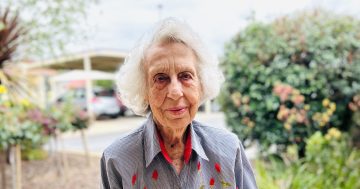
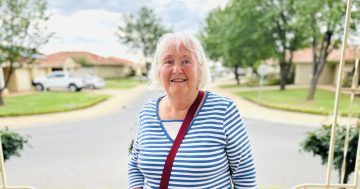
Phil Barton and his grandson Travis before the Rosewood Rally Sprint. Photos: Supplied.
At 81, Phil Barton has no intention of slowing down.
Born in Young, Phil spent more than half a century in Tumut, built a 37-year career in the motor industry, volunteered for more than a decade and published seven books.
But perhaps his greatest achievement is the family he and wife June have built over their 58-year marriage – three children, eight grandchildren and seven great-grandchildren.
Their passion for motorsport now spans three generations. Phil recently returned to the rally course after more than 30 years away, joining son Toby and grandchildren Travis, Ben and Blake at the Rosewood Rally Sprint for a memorable Barton family outing.
These days, Phil and June call Wagga home, having moved from Tumut in 2022 in search of better medical services.
But retirement hasn’t meant sitting still. Phil cycles 80 to 100 kilometres a week, writes, volunteers, advocates for community causes and remains fascinated by technology — including AI.
For Phil, the approach remains simple: stay involved, keep moving, keep learning and don’t be afraid of the next challenge.
As he puts it: “The problem is never the problem; it is how one handles the problem that is the problem.”
Phil caught up with Region for our life lesson series to take us through his life and what he can teach us about work, marriage, longevity and Wagga.

Phil Barton is showing no signs of slowing down at age 81.
What was your first job?
I became a motor mechanic at 16. I was paid five pounds, one shilling and sixpence.
I was living at home and paying two pounds for full board. Mum did all the cooking, washing and ironing, so it was a pretty good deal.
In 1971, I went to work as a service manager during the Snowy Hydro Scheme, where I earned $15 more and met people from all around the world.
You bought your first house in Tumut in 1973. What did you pay?
We paid $18,000 for a three-bedroom weatherboard home. We thought that was a lot of money back then.
It was recently on the market for $559,000.
How did you meet your wife?
My father had a heart attack in 1966 and we rushed him to hospital. June was his nurse.
If he hadn’t had that heart attack, we never would have met.
I pursued her a few months later and we married in 1968. We’ll have been married 58 years this December.
What’s the secret to a successful marriage?
Having empathy for each other.
I was difficult to live with and my wife is more forgiving than the average lady. But we didn’t want to have regrets, and we don’t. We always worked hard to understand each other.
What period of your life do you remember most fondly?
Going to work for Ford in Tumut. One of the owners, Col Couton, brought me into the business as a partner. We remained close friends throughout our working lives and in 26 years we never had an argument. He died last year at 88.

Phil Barton on the day of his retirement – 15 February 2007. Photo: Supplied.
What’s one piece of advice you’d give a teenager?
Take your job seriously. Try to be the most valuable person in the organisation.
How is life different now to when you grew up?
It’s totally different. The pace of life today is too fast.
We’ve got all these electronic gadgets that we didn’t have. When I was growing up, families would gather and listen to radio shows.
Are you a fan of modern technology?
I’m totally up with it. I’m a prolific Facebook user, although it does frustrate me.
I use AI, including Claude and ChatGPT. Used correctly, it’s a wonderful tool.
I do advocacy work on a voluntary basis and ChatGPT has helped me enormously with writing submissions. It’s the future – used properly, we can really benefit from it.
What’s the best thing about Wagga?
The medical services are marvellous. That’s one of the reasons we moved here in 2022.

Phil Barton’s cycling crew: Graham Gillette, Phil Davidge, Dougall McKellar and Dave Pearce, who cycle around Wagga every week with Neil Cole (absent).
And the worst?
I don’t think there’s anything negative about Wagga. It’s what we make it.
Everyone in the community has a responsibility to make this town a better place.
What’s the secret to your longevity?
I’ve got a wonderful, supportive wife and I’ve had some great opportunities in life – people giving me a break at the right time.
I’ve always been physical and I’ve never put things off. If there’s a job to be done, I do it today. I keep my mind active and try to live a stress-free life.
When I was 40 I was asthmatic, but I rarely have an attack now, which I put down to cycling and a healthy lifestyle.
What are you doing in retirement?
I’m still involved in community work and advocacy, writing and cycling.
I spent about 11 years as a full-time volunteer with Snowy Valleys Council and chaired the Tumut-Batlow Rail Trail project for five and a half years.
I’ve also written seven books, including two memoirs about my life.
Do you expect to celebrate your 100th birthday?
It doesn’t worry me.
If I’m in good health, sure. But if I’m not, no.
If I get beyond 90, I’ll be happy.