Leeton councillors have taken a key step towards protecting agricultural land. Pictured are Mayor George Watson (centre) alongside his Deputy Michael Kidd (blue tie) and councillors (from left) Sandra Nardi, Boston Edwards, Nicolas Wright, Stephen Tynan, Krystal Maytom, Sarah Tiffen and Tracey Morris. Photo: Supplied.
Leeton Shire Council has voted to oppose large-scale solar farm developments on irrigable land, backing a proposal put forward by Mayor George Watson.
The motion does not ban renewable energy projects across the shire. Instead, it sets out a policy framework aimed at protecting high-value agricultural land, particularly areas capable of irrigation.
“Council acknowledges the role of renewable energy generation, including solar farms, in supporting the transition to a low-carbon economy,” the motion states. ”However, this must be carefully balanced against the need to protect high-value agricultural land, particularly irrigated land that contributes significantly to sustained agricultural productivity.”
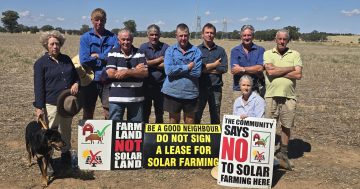
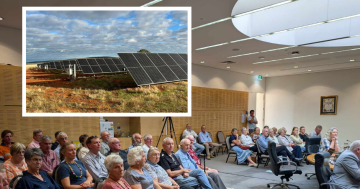
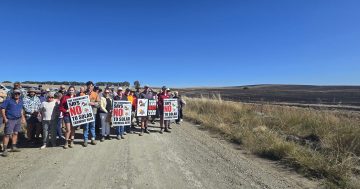
The decision follows a wave of protests across the Riverina over solar farms and battery energy storage projects proposed on or near prime farmland.
Under current planning rules, Leeton Council can determine developments valued at less than $3 million, while larger projects are assessed by the NSW Government.
The motion was passed unanimously at last week’s council meeting, during which prime farmland was described as “precious”. However, one councillor raised concerns about its potential impact.
“I want to make sure there’s no unintended consequences,” Cr Nicholas Wright said.
“That it doesn’t prevent someone in the irrigation areas from putting up a modest amount of solar arrays to run their existing operations as opposed to a large-scale commercial grid provider.”
Mayor Watson said the proposal would not have that effect, noting it allowed for merit-based, case-by-case assessments.
General manager Jackie Kruger also emphasised the flexibility of the approach, describing it as a policy framework rather than a rigid set of rules. She said that where land had reliable access to irrigation water and strong yield potential, “we would not be looking favourably on mass solar farms covering that type of land”.
Cr Boston Edwards backed the motion, framing it as a necessary step to protect the region’s economic base.
“This is about showing our support for the backbone of Leeton’s economy … once prime agricultural land is lost, it’s gone,” he said.
“This motion isn’t about opposing energy projects, it’s about us drawing the line and saying we need to put agriculture first because that’s what feeds the nation.
“The rush to renewables should not come at the expense of our best agricultural land.”
However, the Leeton Ratepayers and Residents Association questioned why similar protections were not extended to dryland farming areas.
“Whether it is solar farms, wind turbines or transmission towers, large energy projects bring a range of operational challenges for all farmers (irrigated and dryland), from machinery access and aerial spraying to transport routes and fire risk,” the association said on Facebook.
“Productive agricultural land cannot simply be the default location for major infrastructure projects. Transmission lines can fragment properties, restrict movement and create ongoing access issues in ways that current generation projects often do not.”