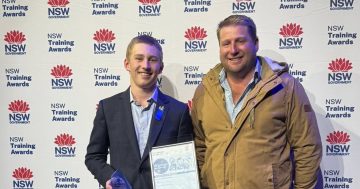
Year 7 students Sophie Mott, Mitchel Bailey and Xavier Curran are three of the 26 students trialling the new High Potential Gifted Education program at Kooringal High. Photo: Jarryd Rowley.
Gifted students at Kooringal High School have been selected to take part in a special extracurricular program backed by the NSW Department of Education.
As part of the Inspire program, the High Potential Gifted Education (HPGE) classes aim to develop recognised skill sets in students across theory- and creativity-based subjects.
Kooringal High School is one of eight schools across the state selected to trial the program, with more set to join in 2027.
While only focusing on Year 7 students in 2026, the program will follow the students through the duration of their high school education.
Kooringal High School curriculum coordinator Sarah Carter said the HPGE classes would consist of giving students tasks they would have to workshop using skills they had learnt during their regular classes.
“We’re really proud to pioneer this space,” she said.
“Our extension program caters to the intellectual and creative students here, who are really good problem solvers, innovators, and use a lot of divergent thinking.
“We give them problems that are happening in our world today and come up with realistic solutions.
“A lot of the work that’s done in the classes is collaborative. Students enjoy working with like-minded people to bounce ideas and come up with those solutions.
“We find that they are more easily able to transfer their learning from areas like maths and science to actually deepen their understanding of the curriculum, and then take that forward and apply it in their lives.”
Mitchel Bailey is one of the 26 students selected for the program and was chosen after completing a project on his first day of school. The project tasked students with overcoming an issue of their choosing and explaining how they would overcome the problem.
In Mitchel’s case, he chose fishing and nets that collect too many fish. By using his knowledge of science and engineering, he came up with a concept net that would remove fish once the net was full.
“We do a bit more work than the others – work that’s a bit harder and a bit more hands-on, like projects and group work,” he said.
“We’ve had a few classes already, a couple focused on science and conducting experiments. Another was a design class where we came up with an idea for a video game.
“I wouldn’t say it’s more work than our normal classes, but it definitely is a different way of using what we have learnt. We try to show what we’ve learnt and how it works in the real world.”