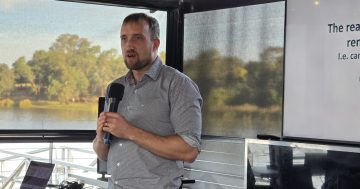
Climate Change and Energy Minister Chris Bowen announcing solar panel incentives during his address to the National Press Club. Image: Screenshot.
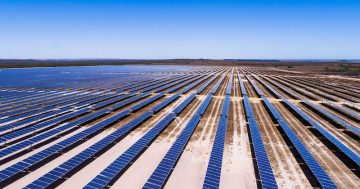
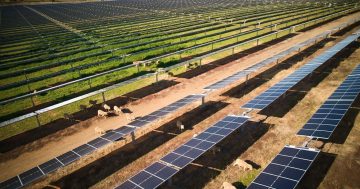
Labor wants to see more rooftop solar panels on small businesses, community organisations and farms, and is changing regulations to help make that a reality.
The Federal Government will cut the cost of installing medium-sized solar systems by about 20 per cent and expand the Small-scale Renewable Energy Scheme (SRES) from 100 kW to 1 MW, enabling facilities to install solar systems up to 10 times larger.
Climate Change and Energy Minister Chris Bowen has moved to provide an incentive discount and cut red tape for solar panel installations for businesses.
He told the National Press Club on Wednesday (5 August) that he had requested the Australian Energy Market Commission consider a rule change to make network providers approve commercial and industrial solar “much more expeditiously and efficiently” than they have been doing.
The minister said while rooftop household solar continues to break records, there was a missing middle in Australia’s energy transition.
“The missing middle is mid-scale solar,” he said.
“Factories, warehouses, farming sheds and large industrial premises – big empty roof space ripe for solar generation.
“The data backs this up. According to the Institute for Energy Economics and Financial Analysis, while Australia’s residential solar capacity is 22 gigawatts, businesses have installed only around 5.6 gigawatts.
“Estimates vary, but the technical rooftop potential for solar on commercial, industrial and agricultural rooftops could exceed 80 GW.
“That’s an opportunity we should miss no longer.”
Mr Bowen said the government will improve network connection processes for mid-scale solar projects through targeted rule change requests and enhancements to the existing framework.
“Many businesses have told me that if they are inclined to install large rooftop solar, they have encountered delays in getting their network service provider to approve the installation,” he said.
“While I understand these can be complex questions that need to be worked through, many of the delays I have heard about are unacceptable and simply make it so hard for businesses to install solar that they just give up.
“I want to end that roadblock.”
The discount will be delivered by expanding the SRES, which has been providing discounts for solar upgrades since 2011 and has supported more than 490,000 Cheaper Home Batteries program installations since 2025.
Based on mid-scale solar PV system installations, the estimated discount is about $68,000 off a 250 kW system, which is enough to support a reasonably large commercial operation, or $136,000 off a 500 kW system to power a small manufacturing site.
The minister flagged the expansion of the SRES as expected to be budget neutral.
Each installation generates certificates which are then traded on the open market.
The SRES is administered by the Clean Energy Regulator, and the federal scheme is separate from state-run rebates.
It has always had a small compliance cost for retailers, which is designed to continue to decline each year through 2030, with incremental compliance costs from adding these larger systems amounting to only an extra $1 to $2 a year per average household power bill.
Expanding the SRES to include solar installations up to 1 MW in size will lower the upfront installation costs for commercial, industrial and agricultural buildings by around 20 per cent.
The expanded SRES is expected to commence from 1 October this year, subject to the necessary regulations being in place.
Mr Bowen also used his press club address to highlight that coal had become an unreliable energy source because of ageing assets.
“A little over two years ago I addressed the National Press Club and shared a key fact,” he said.
“Back then, I told this room that in the year before that speech, not a single day had passed without an outage at a coal-fired power station in eastern Australia. Not one day.
“Well, I can report back. In the two years since, still not a single day. Not one.
“Three years in a row. Every single day. A coal outage somewhere in eastern Australia … Coal isn’t baseload power anymore; it’s an unreliable asset. Every time coal breaks down, your bills go up.
“This isn’t to criticise the good men and women in those regions working hard to try to keep these things running. It’s simply economics and engineering.
“Our coal assets are ageing. The average age of our coal power stations in the national energy grid is 38 years. They need to be replaced.
“Some want to sweat these coal assets for longer. To rely on them more, not less. To ignore reality and mislead Australian people.
“That’s a recipe for unreliability. For blackouts. And for increased bills. We have a different plan – to replace ageing coal-fired power with new, abundant renewable energy, backed by storage and gas peaking.”
Original Article published by Chris Johnson on Region Canberra.