It’s hard enough to teach kids manners, so when grown-ups let the side down, it’s hard to know what to do. Photo: Unsplash.
Poolside signs inform parents it’s their responsibility to supervise their children. Sports field sandwich boards remind parents that it’s just a game. Every theatre performance begins with simple housekeeping- no food or drink, phones off, no flash photography.
And yet, there’s always the phantom parent who assumes others will babysit their child, inflammatory language bandied about on the sidelines at kids’ sports, and some joker will always manage to disrupt the entire theatre with their own pathological need for attention.
So, what to do when adults behave badly?
If you’re an undercover Muay Thai fighter with intimidating stature and a formidable oak-stained hue, you might simply rip your shirt off and serve up a string of expletives to frighten them off. But we all have our own methods …
Introverts may opt to ignore poor behaviour and make deep eye contact with inanimate objects around them. Extroverts may escalate a situation by addressing the problem directly.
But my question is: Won’t somebody think of the children?
Those little sponges are soaking in everything around them. Consciously and unconsciously, they’re assessing the world around them and deciding daily whether to go down the path of good or evil.
When I’m confronted with adults displaying “bad behaviour”, and kids bearing witness, it can present a real conundrum.
Quotes and platitudes swirl in my head. Do I show my kids how to be an upstander, not a bystander? Am I being the change I want to see in the world? But aren’t I also supposed to show them how to rise above, be the bigger person and turn the other cheek?
Most of the time, I find there’s no need for intervention – maybe just a debrief afterwards.
For example, at a recent school district performance that will remain nameless, I quickly grew weary of the personal shoutouts, poorly timed cheers and, unbelievably, one wolf whistle.
There are 1200+ people in the auditorium and dozens of kids on stage trying to focus on their moment – but sure, now is the time to yell “GO SARAH!”
The collective cringe was thick in the air, and let me tell you – the wolf whistle might have found me testing out my Muay Thai skills if the house lights had revealed its origin.
Admittedly, sometimes I am the problem.
Mummy meltdowns over small things are usually followed by an apology and terms like “window of tolerance”, “empty bucket”, or “perimenopause”.
Of course, most examples of adults exhibiting “bad behaviour” are subjective, easily dismissed or minor irritations. However, sometimes kids witness more serious events which demand a response.
I recall one occasion when I felt forced into action because someone’s safety was at risk.
One day out walking, with my littlies trailing behind on scooters, we came upon what appeared to be a domestic violence incident. A woman, with a baby on her hip and tears streaming down her face, was attempting to flee her irate partner as he chased her down and blocked her path – at one point, prostrating himself in the middle of the road in protest.
Cautiously, I altered our intended path and made myself known as an approaching witness, and thankfully this simple encroachment saw the abuser abandon his efforts.
I offered the victim some wholly inappropriately light-hearted words (to avoid traumatising little ears). We walked her to her car, and I left her with pointed eye contact and the words, “Please stay safe”.
I still think about this incident for a few reasons. But it serves as a poignant example of adults behaving extremely badly and the challenge we face teaching kids to behave when they see adults doing differently – while keeping our response safe and appropriate. And that’s not always easy to gauge.
All adults are role models to our children. Some will set an admirable example, while others will demonstrate how not to behave.
I suppose our job is to help kids decipher which is which – it’s just not always clear how. And how we respond may end up teaching the bigger lesson.
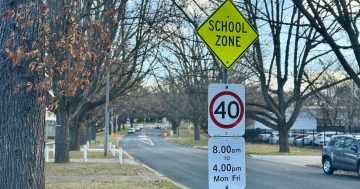
Of course, it would be so much easier if everyone would just heed the signs – watch your kids, cool your boots, sit down and shut up.
But I suppose we’re still learning too …
Original Article published by Hayley Nicholls on Region Canberra.