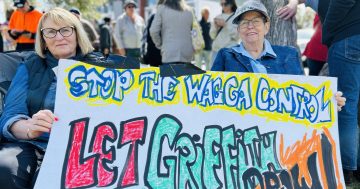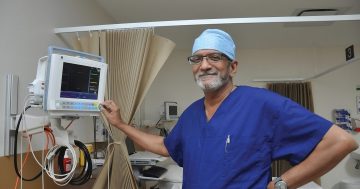

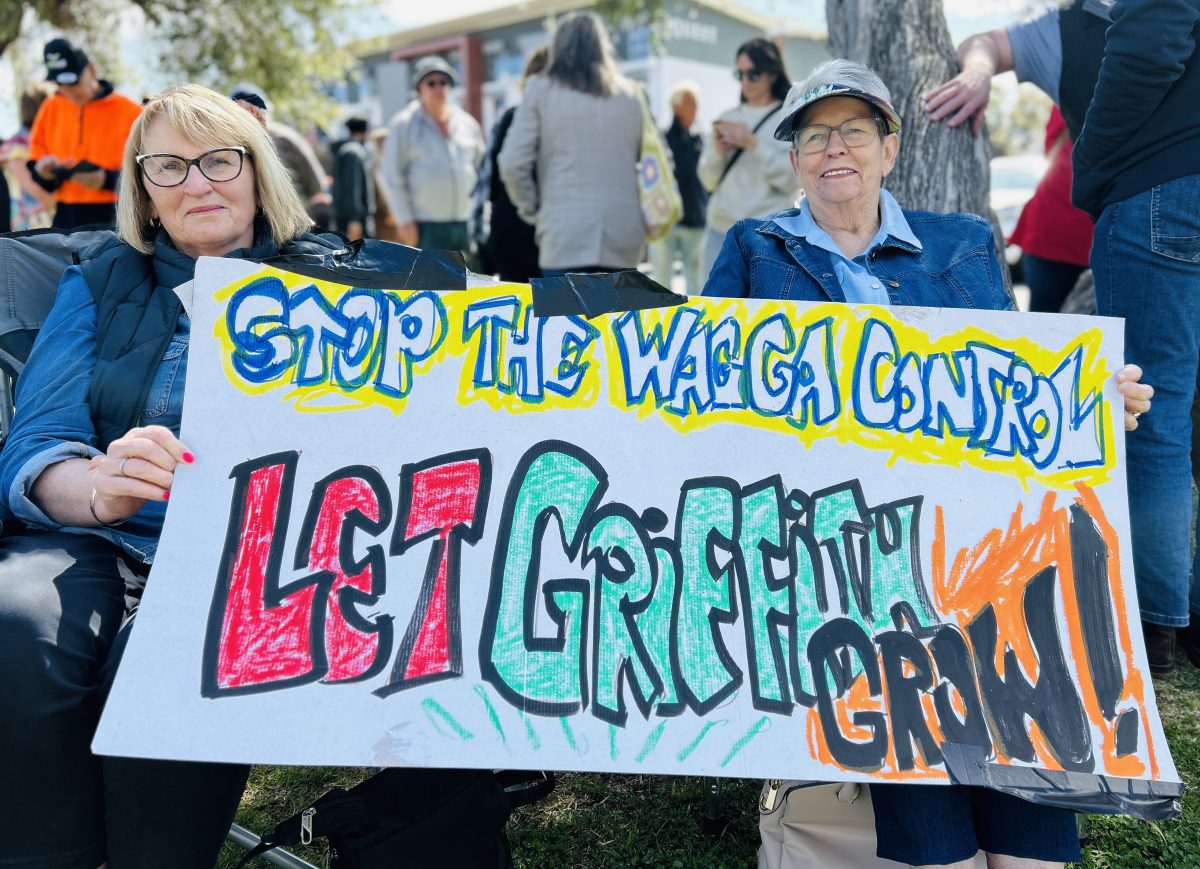
Retired farmer Marlene O’Connell and hospital canteen worker Judy Saddler express support for Griffith Base Hospital splitting away from MLHD. Photo: Oliver Jacques.
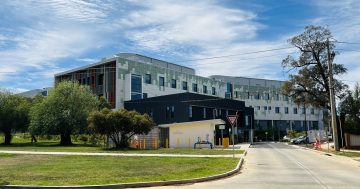
Griffith has a beautiful, shiny new hospital, complete with landscaped green spaces and electric vehicle charging stations.
What it doesn’t have is an onsite paediatrician, mental health services or an MRI machine. Its rehabilitation ward remains unopened, dozens of nursing positions are unfilled, and patients needing specialist treatment are sent elsewhere. Despite the lack of services, finding a parking space is still a nightmare.
Who could have predicted the new hospital would be beset with so many problems? Answer: almost everyone in Griffith.
Local surgeon Dr Narayanan Jayachandran warned the Wagga-based Murrumbidgee Local Health District (MLHD) and Sydney-based Health Infrastructure about the need to consult local doctors on the clinical services plan.
The doctors were ignored. Now Griffith is paying the price.
The parking fiasco is a classic example of the disconnect between outsider decision-making and reality on the ground.
The government demolished the old nurses’ quarters, despite a local building expert arguing they were structurally sound and could be repurposed for modern accommodation.

The old nurses’ quarters at Griffith hospital were demolished and now the MLHD plans to build accommodation where the old carpark used to be. Photo: Sherene Blumer.
Now MLHD has realised hospital staff need somewhere to live in a town with a chronic rental shortage. The Wagga bureaucrats plan to build new accommodation on land previously used for parking.
The result? Patients spending up to an hour searching for spaces while overworked nurses park outside the facility and hike to work.
Perhaps someone in Wagga or Sydney assumed that, because Griffith is a country town, patients and staff could simply park on the surrounding streets.
They clearly haven’t driven along Animoo Avenue, where cars crowd both sides of the road and a delivery truck was recently unable to get through.
Health advocate Yvonne Turnell has warned the situation is an accident waiting to happen.

Debra Butcher and Vicki Greedy have spent countless hours driving around the hospital carpark in circles. Photos: Oliver Jacques.
It’s hardly an ideal way to attract more staff to an already understaffed hospital.
But MLHD isn’t helping on that front either. Local doctors have alleged that specialists willing to work in Griffith were turned away because the district refused to create positions for them.
If those allegations are correct, it is an extraordinary failure. Griffith residents are travelling hours for treatment while doctors prepared to provide that treatment are allegedly being blocked by the very bureaucracy responsible for delivering healthcare.
Children who need paediatric care are put on a two-year waitlist. Patients needing orthopaedic treatment have to be driven to Wagga. The rehabilitation ward remains unopened.
There is an inherent conflict of interest in having a Wagga-based administration decide on Griffith’s specialist services and resources.
When Griffith patients are referred to Wagga, the treatment stays there. If Griffith attracts more specialists, some of that work could stay local, potentially taking referrals away from Wagga.
That doesn’t prove MLHD is deliberately protecting Wagga at Griffith’s expense, but suspicions are justified given the Wagga bureaucracy has repeatedly declined to answer questions about the allegations.
The MLHD recently showed just how tone deaf it was with Griffith’s concerns when it launched a marketing campaign celebrating the hospital’s EV chargers and solar panels while the town was crying out for more doctors.
This is why the push for a separate, Griffith-led health district has gained support from local doctors and the vast majority of Griffith residents. This week, a petition calling for a new Western Riverina Local Health District, which would take Griffith and surrounding communities out of the MLHD, reached 10,000 signatures.
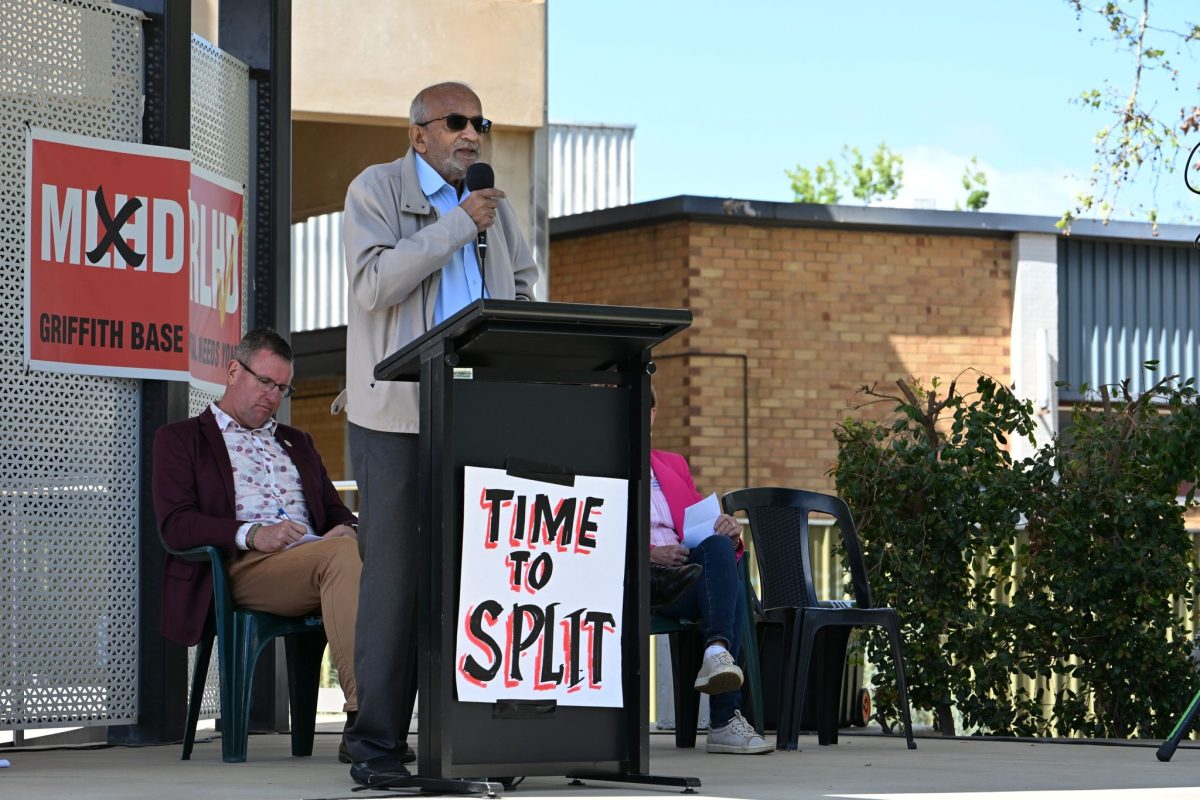
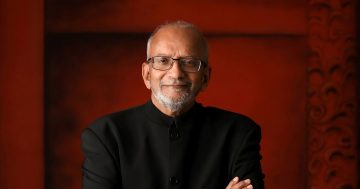
Veteran surgeon Dr Narayanan Jayachandran has championed the split. Photo: Denny Fachin.
That milestone triggers a debate in NSW Parliament on the proposal. It is a remarkable show of community frustration.
Splitting from MLHD would not magically solve workforce shortages or guarantee better management. But local decision-makers would be closer to the doctors, patients and communities affected by their decisions, and harder to excuse when things go wrong.
A hospital is not judged by how shiny its building is and the number of EVs it can recharge. It is judged by whether patients can get the care they need.
Griffith was promised a new hospital that would improve healthcare across the western Riverina. The building has arrived. The services have not.
After years of warnings, delays and unanswered questions, Griffith residents should not have to keep pleading with Wagga for the healthcare they were promised.
If MLHD cannot explain why the new hospital is falling short, it is time to let Griffith take responsibility for its own future.