Brendan Catanzariti, Yvonne Turnell and Virginia Tropeano gave evidence to the inquiry. Photo: Oliver Jacques.
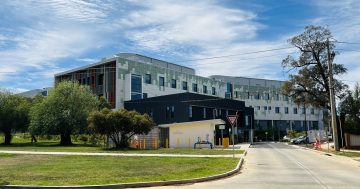
Griffith Base Hospital staff are so tightly controlled from Wagga that they must seek approval to adjust the facility’s air-conditioning, a parliamentary hearing was told on Thursday (12 March).
The inquiry also heard there were no plans to replace the hospital’s recently deceased head paediatrician, Professor Maxwell Hopp, that the rehabilitation ward remained unopened despite earlier promises, and that alleged “bullying” had contributed to high staff turnover.
Local health advocates Brendan Catanzariti, Virginia Tropeano and Yvonne Turnell gave evidence to a panel of NSW MPs at the Griffith Regional Theatre. The hearing forms part of an inquiry into Helen Dalton’s bill to separate Griffith Base Hospital from the Murrumbidgee Local Health District (MLHD), the Wagga-based authority responsible for staffing and resourcing decisions across the region.
How to adjust the aircon in Griffith
Mrs Dalton asked the advocates how much control Wagga exercised over the hospital.
“They are so controlled by Wagga that they almost have to ask Wagga when they can have a toilet break. Is that the case, is that what you’ve heard to?” Mrs Dalton asked the advocates.
Ms Tropeano said she heard from someone having a procedure who complained it was too hot and asked for the air-con to be turned up.
“[Staff] told him they were not allowed to adjust the air-conditioning; it has to be done through Wagga. I thought, ‘My God, that is awful.'”
No replacement for beloved children’s doctor
The local businesswoman also raised concerns about paediatric services, which have been stretched since the tragic death of Professor Maxwell Hopp in September 2025.
“Learning that the MLHD have no plans to replace the late Dr Hopp is just unbelievable. Does this mean that this wonderful doctor and all he’s done for children in the past 30 years has been discounted as unnecessary to replace? I guess all the families who relied on him will now have to find a paediatrician in Wagga,” Ms Tropeano said.
Why staff won’t stay
Real estate agent Brendan Catanzariti told the panel the hospital’s rehabilitation ward still had not opened, despite earlier assurances it would be operating by 2025, and that the step down ward next to emergency was also still not open.
He also said local Griffith GPs were willing to assist with emergency work at the hospital, but MLHD instead chose to fly in locum doctors from other cities at significant cost to taxpayers.

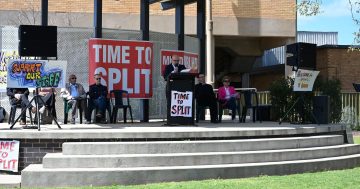
Protesters were out in force before the hearings. Photo: Office of Helen Dalton MP.
The inquiry committee asked whether he believed a standalone Griffith hospital would be able to attract staff.
“We don’t have a problem attracting staff, we have a problem retaining staff,” Mr Catanazariti said.
He said the hospital had lost a lot of good doctors, specialists and nurses, including eight from one department.
“Sometimes, there can be bullying in the system, if there’s no strong leadership, the natives run riot … we’ve got good nurses that won’t go back to the hospital, why is that? That’s the question the Department of Health should answer,” he said.
Ms Turnell said nurses and doctors’ input were ignored during the planning stages of building the new hospital and that Griffith was paying the price.
“They did everything wrong; they put everything in the wrong spot; they did a plan with a hospital, they didn’t put enough windows in, that had to be redone; that’s our money used for their mistakes,” she said.
MLHD response
Region asked MLHD if it were true that Wagga controlled Griffith hospital’s air-conditioning, if it had plans to replace Professor Hopp, if the rehab ward was still not open and how many reported incidents of bullying there had been at the hospital in the past two years.
A spokeswoman said MLHD was unable to answer these questions while the inquiry was in progress, but provided the following statement.
“Murrumbidgee Local Health District (MLHD) is committed to ensuring we continue to provide high-quality and accessible patient-centred care to all the communities we serve,” the spokeswoman said.
“Health care services in MLHD are highly networked and have been developed to ensure patients across the district receive appropriate care depending on their clinical needs. A networked district also delivers advantages in funding and efficiency. Our submission to the inquiry is published on the Parliament NSW website.”