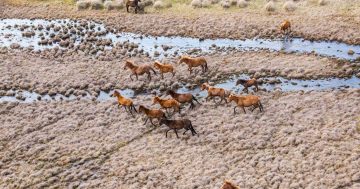
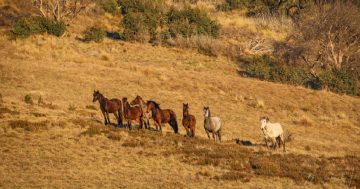
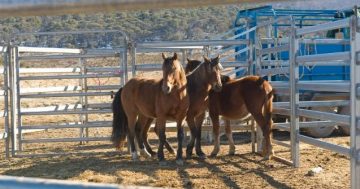
Wild horses (brumbies) in Kosciuszko National Park, where debate continues over aerial shooting, population estimates and future management options. Photo: NSW Environment.
Brumby rehomers and advocacy groups are calling on the NSW Government to pause upcoming aerial shooting operations in Kosciuszko National Park (KNP), arguing the state’s own latest population report raises enough uncertainty to justify an independent review before more wild horses (brumbies) are culled.
The renewed push comes after the recent release of the NSW Government’s 2025 wild horse population survey, which estimated there are between 6476 and 16,411 horses in the park, with a best estimate of 10,309 animals.
The figures marked a substantial increase on the previous year’s estimate of between 2131 and 5639 horses and prompted NSW Environment Minister Penny Sharpe to signal further population control measures would be needed to meet the legislated target of reducing horse numbers to 3000 in designated retention areas by mid-2027.
But a coalition of approved NSW rehomers, the Australian Brumby Alliance (ABA) and Tarcutta-based wild horse sanctuary Umbango South has now challenged both the timing of the planned aerial shooting operations and aspects of the survey methodology itself.
In a joint media release issued last week, the groups argued there was “no deadline” forcing aerial shooting to resume immediately, noting the legal target date under the current management plan remains June 2027.
The groups are calling on the government to pause operations, release the survey for independent review and meet with the rehoming sector and representatives of the Ngarigo people before further aerial shooting occurs.
Jenni Cole, managing director of Umbango South, said the latest figures appeared to reflect changes in counting methods rather than a dramatic increase in horse numbers.
“A population can’t triple in a year – that’s not opinion, it’s biology,” Ms Cole said.
“The horses didn’t change; the counting did.”
The rehomers point to wording within the government’s own report stating the horse population “may not have changed as much as the point estimates alone might otherwise suggest”.
They also argue the 2025 survey differed from previous years because it used front and rear helicopter observers and included extrapolated estimates in some retention areas where terrain could not safely be surveyed.
The ABA has also continued to question aspects of the population modelling and called for an independent review of the survey methodology before further aerial shooting operations proceed.
Similar concerns around growth rates and interpretation of the estimates have also been raised publicly by equine scientist Dr Joanne Canning and biostatistician Claire Galea.
Another issue raised by advocates is peer review.
The groups say the 2022 and 2023 reports identified independent peer reviewers, including CSIRO and the Queensland Department of Agriculture, while the 2025 report does not explicitly identify peer reviewers within the published document.
However, the NSW Government has stated the latest survey methodology was independently peer reviewed and continues to maintain the surveys use internationally recognised aerial distance-sampling methods widely used in wildlife population monitoring across difficult terrain.
The same day the government released its latest wild horse population survey, it also published an independent report examining fertility control options for wild horses in KNP.
The report found fertility control could potentially play a role in maintaining lower horse numbers in the future but concluded it was not currently practical as the primary management tool while horse populations remained high and widely dispersed across the park.
The report examined a range of reproductive control methods, including dart-delivered immunocontraceptive vaccines used overseas in wild horse populations.
Speaking following the release of the report, Ms Sharpe said the government was continuing to investigate reproductive control methods, including dart-based fertility control, but said “we’re not there yet because the population is too high”.
The government has also confirmed the NSW National Parks and Wildlife Service (NPWS) will engage an independent expert to help design an initial fertility-control trial.
For brumby advocates, however, the report has renewed calls for greater investment in non-lethal alternatives.
The rehomers say they have already rehomed more than 1165 horses removed from the park without government funding and are continuing to push for expanded trapping, fertility control and sanctuary programs instead of aerial shooting.
Their proposal, partly modelled on New Zealand’s Kaimanawa horse management program, argues a non-lethal approach could operate at a fraction of the cost of ongoing aerial control.
The groups also claim they provided a draft proposal to NPWS and government representatives weeks ago but received no substantive response before the latest survey figures were publicly released.
Conservation groups reject suggestions that aerial shooting should be paused, arguing the latest population estimate demonstrates how quickly horse numbers can rebound if active management slows.
The Invasive Species Council said ongoing horse impacts on fragile alpine ecosystems were well documented and supported continued population reduction.
With aerial shooting operations due to begin from 9 June, brumby advocates are continuing to ramp up pressure on the NSW Government through petitions, letter-writing and social media campaigns and calls for greater investment in trapping, rehoming and fertility control.
Temporary closures will be in place across parts of the park during upcoming feral animal control operations targeting wild horses, deer and other pest animals, with visitors urged to check the NSW National Parks alerts page before travelling.
Original Article published by Edwina Mason on About Regional.