


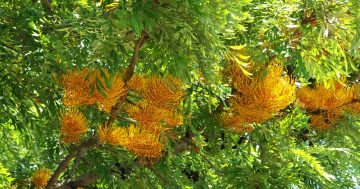
The legal dispute was over two large Canary Island date palms. Photo: Quartl/file photo only.
An Albury woman has won a two-year battle with her neighbour over two towering palm trees, with a court ordering they be removed after finding they damaged a shared fence and posed a risk of injury.
The NSW Land and Environment Court ruled that two Canary Island date palms growing in a backyard had bent and torn a metal boundary fence, with the damage expected to worsen if the trees remained.
Judith Mary McKeown shares a rear boundary with Anke Beate Woeckel, separated by the 1.4-metre-high fence.
According to the published judgment, two large Canary Island date palms growing at the rear of Ms Woeckel’s property were pushing against the fence, causing it to stretch and bend towards Ms McKeown’s land.
The palm trees were estimated to be 20 to 30 years old and had received little pruning or maintenance. Their fronds (large leaves) stretched about five metres in every direction, hanging over the neighbour’s roof and backyard while pressing hard against the fence.
Ms McKeown said she visited Ms Woeckel about two years ago, explained the damage the palms were causing and asked her to remove the trees and repair the fence. However, Ms Woeckel refused, saying the palms provided privacy and wildlife habitat. At a second meeting about six months later, Ms McKeown said she provided quotes and Ms Woeckel agreed to obtain quotes of her own, but no action was taken.
Ms McKeown said she had previously trimmed the fronds to the fence line but “they are now far too big to do that”. She also said she required surgery after the tip of a palm spine became lodged in her wrist, arguing the trees posed a risk of injury.
While acknowledging the palms provided privacy for both properties, Ms McKeown argued they would continue damaging the fence and her home while posing an ongoing safety risk. She took the matter to court seeking an order to remove the trees and repair the damaged fence.
Ms Woeckel argued the court documents had not been properly served, claiming they were shoved under her door and she “tripped over them on return from a work trip”. She also argued Ms McKeown had not proven she was legally entitled to bring the application because the fence belonged to the strata owners corporation. Ms Woeckel said the palms provided privacy for both properties, making a taller replacement fence unnecessary, and argued the dispute could be resolved by pruning the fronds.
She also said the palms contributed to biodiversity and wildlife habitat, claiming Albury City Council had approved “a massive amount of tree removals in the last five years”, leading to “the stark demise of wildlife habitat around here”.
Acting Commissioner John Douglas inspected the palms and the fence before finding the trees had damaged and distorted the shared boundary fence.
“I was persuaded that the palm fronds’ bulk and size and proximity to [Ms McKeown’s] dwelling, combined with long sharp thorns along both sides of the base of each frond, caused the palms to present a genuine risk of injury to persons,” he ruled.
The acting commissioner agreed the court documents had not been properly served but found Ms Woeckel had suffered no disadvantage because she was aware of the proceedings and had ample opportunity to prepare her case.
He also found Ms McKeown had made reasonable efforts to resolve the dispute before going to court, including visiting her neighbour, obtaining quotes and arranging for repeated letters to be sent by her strata manager.
While Mr Douglas accepted pruning would temporarily relieve pressure on the fence, he said it would not solve the problem because the trunks would continue to thicken as the palms matured, making future damage likely.
The court ordered Ms Woeckel to engage qualified arborists to remove both palms, including grinding out the stumps, within 45 days.
She must also pay for repairs to the damaged boundary fence within 90 days.
Alternatively, if both neighbours agree to replace the existing fence with a new 1.8-metre Colorbond fence, Ms Woeckel must pay 70 per cent of the cost and Ms McKeown the remaining 30 per cent.
The acting commissioner declined to order reimbursement of Ms McKeown’s court costs, noting he did not have the power to do so and that such applications must be made separately before a registrar or judge.







I keep reading about how many "jobs" these data centres create. Apart from the obvious employment… View