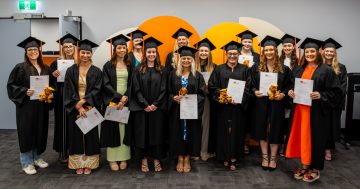
Do we need more university graduates in Australia? The facts suggest otherwise. Photo: ANU.
Australian universities are in crisis, apparently – losing money, cutting jobs, addicted to foreign student cash cows and lowering entry standards to remain viable.
Predictably, this has led to calls for more taxpayer money to save these billion-dollar institutions.
But perhaps this crisis is our opportunity to question the value of what we’re trying to save, how important tertiary education really is, and whether we’d be better served encouraging more of our kids into vocational trades that teach practical skills.
Australia has long promoted the uncontested view that university should be the ultimate goal for school students, with TAFE seen as the poorer cousin for those not clever enough.
The federal government continues to push this narrative, setting a target of having 80 per cent of working-age Australians hold a tertiary qualification by 2050.
It’s a strange goal to pursue at a time when we’ve never had more university graduates, but still have chronic skills shortages and can’t seem to find enough people who can build a house, fix a pipe or keep our infrastructure running.
Perhaps the problem isn’t that too few people are going to university, but too many.
In his book The Case Against Education, American economist Bryan Caplan explains why our love of formal education is misplaced.
He argues that the value of education doesn’t come from what we actually learn. Much of what students are taught is quickly forgotten, and much of what they do retain has little practical value in the workplace.
Instead, Caplan argues, a lot of education’s value comes from something else entirely: signalling.
A degree tells an employer you’re intelligent, conscientious and capable of sticking at something difficult for several years.
The problem is that when everyone gets a degree, everyone needs one – fuelling what he calls “credential inflation”.
A bachelor’s degree has become the new high school certificate. Jobs that once required no degree suddenly require three years of university just to prove you’re capable of doing them.
And here’s the really perverse part: Caplan shows that three years of university without graduating tends to be worth little more in the job market than not going at all.
You would think an employer would value the fact you’ve spent so long learning – but they don’t; they demand a completed qualification.
The education is supposedly the point. But the piece of paper is what everyone is actually buying.
While others call for free university education to expand access, Caplan makes the point that the learning part is already free.
When I studied at ANU, nothing stopped unenrolled people attending lectures or sitting in on tutorials. Academics were generally flattered by those who wanted to learn for learning’s sake.
But almost nobody did it.
Why?
Because they didn’t want to learn for learning’s sake. They wanted the piece of paper at the end.
You can now access lectures from some of the world’s best universities online. You can learn almost anything you want for free.
What costs money is the institution that sits between you and the piece of paper.
It’s no surprise that a recent survey found university graduate satisfaction had fallen to record lows and there’s been a sharp rise in the number who felt they were “overqualified” in their employment.
That doesn’t mean university is useless. Obviously, we need doctors, engineers, scientists and teachers.
But we should question why we have convinced ourselves that everyone needs a degree and why taxpayers should prop up tertiary institutions.
University is disproportionately populated by young people from more advantaged backgrounds.
That means the carpenter who left school at 17 and went straight into an apprenticeship can end up helping subsidise the university degree of someone from a wealthier family, even though it may be the tradie whose skills are more urgently needed by the economy.
And there is another reason to question whether we’re putting too much faith in university education: technology is likely to make more university graduates redundant than those with a trade.
You can train AI to write an essay about gender studies, but not fix your toilet or wire your house.
And you can’t train it to replace the plumber who is charging you $150 an hour because he’s the only one available.
We have spent years telling teenagers that TAFE is for the kids who aren’t smart enough for university. Then we wonder why we have skills shortages.
It’s time to do the opposite: celebrate and promote vocational education, and gently guide those of us (like me) who can’t hack manual labour into tertiary classrooms.
The current crisis shouldn’t simply become an excuse for another taxpayer bailout.
It should be an opportunity to ask whether we’ve spent decades expanding a system that didn’t need to become this big in the first place.
That just might be what a clever country would do.
Original Article published by Oliver Jacques on Region Canberra.