

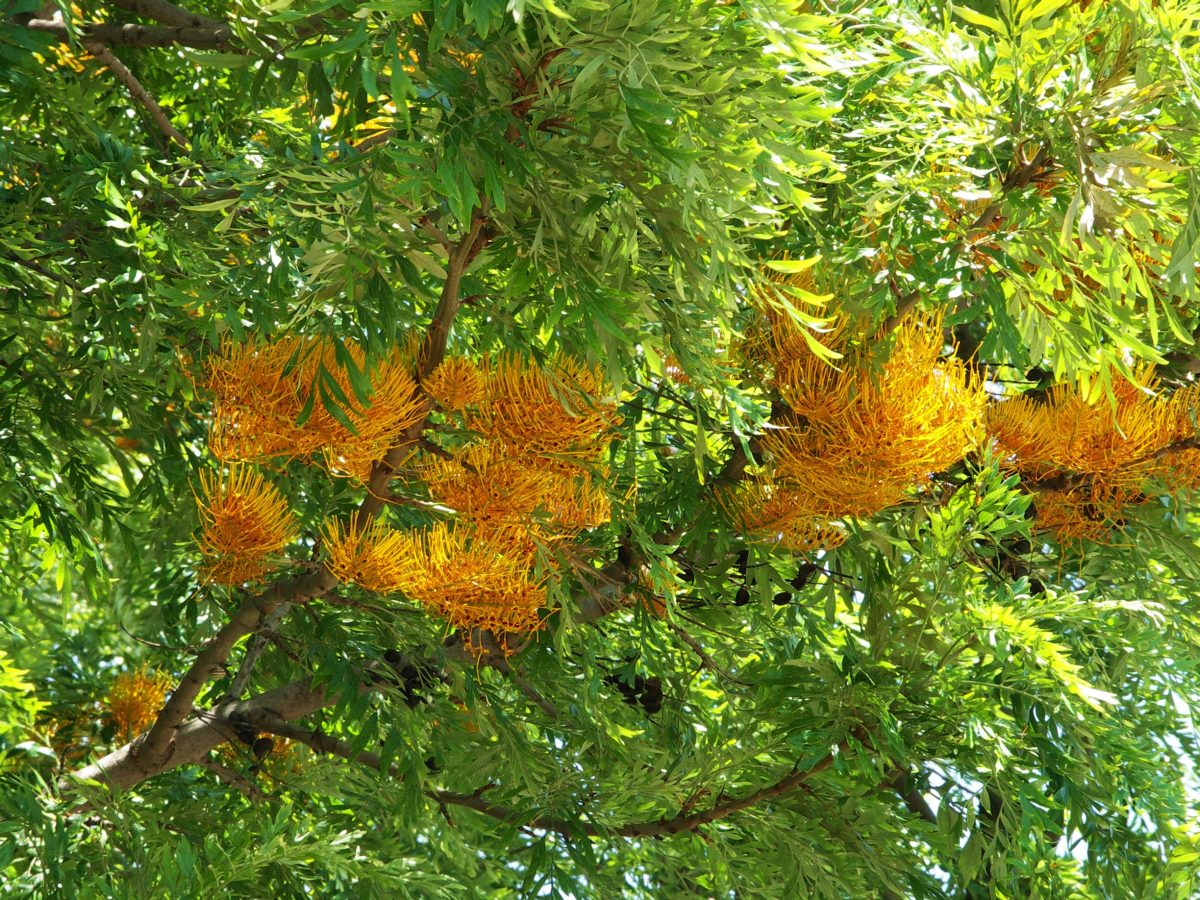
A Lockhart man claimed silky oak trees were “environmental weeds” but the commissioner ruled there was no evidence to support this claim. Photo: Wikipedia commons/file photo.
The NSW Land and Environment Court has rejected a Lockhart man’s application to have four of his neighbour’s trees knocked down, after claiming they damaged the dividing fence and his shed.
Neil Phillips sought the removal of two silky oak trees, a Norfolk Island hibiscus and lemon-scented gum tree situated on land owned by Simon Peters, who lives at an adjoining residential property in Lockhart (near Wagga). Mr Phillips claimed the silky oaks and hibiscus were “environmental weeds”.
He wanted Mr Peters to pay him compensation for damage to his shed, and fix or replace parts of their shared dividing fence.
However, after inspecting both properties and considering submissions from the parties, Commissioner David Galwey found the trees had not caused significant damage to Mr Phillips’ property.
The commissioner noted the shed’s cracked concrete was largely due to its age and poor construction, rather than the nearby trees.
Commissioner Galwey said there was no evidence the tree species were “environmental weeds” and found that while Mr Peters’ trees did damage the dividing fence, this was caused by trees that fell before Mr Phillips purchased his property, so he had not suffered a loss.
Mr Phillips claimed the roots of one of the silky oaks, which is 10 metres tall, damaged his shed.
“It has cracked and lifted the concrete slab. The lift height of the main crack is approx. 100 mm. The shed is also on a lean which I believe is caused by the uplift of the tree,” he wrote in a submission.
He sought just over $15,000 to replace the shed and concrete slab.
Commissioner Galwey rejected his claims.
“The overall condition of the slab would not be much different to its current state even without the presence of roots from [the silky oak]. I also find that the slab was most likely cracked to a significant degree when Mr Phillips purchased his property. He bought the property without inspecting it himself, and has no doubt discovered several issues since then,” his written judgement stated.
Mr Phillips argued that the branches of the Norfolk Island hibiscus had damaged the dividing fence, but Commissioner Galwey said he found no evidence to support this claim.
The Lockhart applicant also claimed Mr Peters’ 16-metre lemon-scented gum tree caused a risk to the public, because its branches spread over a public laneway and could fall off and injure passersby. The Commissioner found the laneway was not busy and the tree was unlikely to cause any injuries.
Commissioner Galwey rejected Mr Phillips’ claims for compensation and tree removal and ordered he give Mr Peters access to his property to repair any minor damage to the dividing fence.







If the police are seeking witnesses, it would be helpful if they identify the fast-food restaurant… View