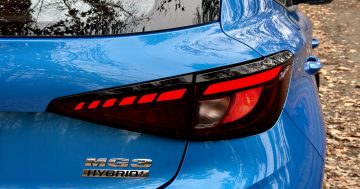
Popular: The Chinese BYD Sealion 7 ranked fourth in VFACTS vehicle sales in the ACT for March. Photo: James Coleman.
Industry figures have called for more investment in electric vehicle charging infrastructure, especially in the regions, after long queues at highway chargers marked Easter travel, and new figures showed a surge in sales in both new and used EVs.
The VFACTS sales data for March shows the number of Battery Electric Vehicles sold in the ACT was double that of the same month in 2025, reflecting a nationwide surge driven by the Iran war-induced fuel crisis.
One in five vehicles sold were BEVs, double the share of March 2025, with the BYD Sealion the fourth most popular choice among Canberra buyers.
Overall, actual vehicle sales were fewer than a year ago, down 78 units or 4.7 per cent from 1657 to 1579.
But BEV sales totalled 326 last month, up 155 or 90.6 per cent on the 171 sold in March 2025.
There were also 175 plug-in hybrids sold in the ACT in March, 11 per cent of sales, and 360 conventional hybrids (22.8%).
VFACTS does not report Polestar and Tesla sales, but Electric Vehicle Council figures show the combined number for these brands in the ACT was 95.
When these numbers are incorporated, a total of 1674 vehicles were sold in the ACT: 25.1 per cent were battery electric, 10.5 per cent were plug-in hybrid, and 21.5 per cent were hybrid. Around 43 per cent were internal combustion engines.
As of 6 April 2026, the ACT had 15,030 registered EVs, accounting for almost 4.4 per cent of all vehicles.
The Federal Chamber of Automotive Industries said the latest release of VFACTS sales data showed EV sales increased significantly in March, reaching their highest share of the Australian market to date.
A total of 15,839 battery electric vehicles from all sources were sold in March, accounting for 14.6 per cent of total sales, compared with 7.5 per cent of sales in March 2025.
Chief executive Tony Weber cautioned the increase could be temporary due to fuel spikes, but if it was the start of a long-term shift, Australian governments would need to sharpen their focus on public charging infrastructure, particularly in regional areas and locations where home charging was not practical.
“Ensuring infrastructure keeps pace with consumer demand will be critical to enabling sustainable growth in EV adoption beyond short-term influences,” he said.
Mr Weber said the automotive industry would welcome a sustained shift to EVs, given its substantial investment in bringing more than 100 EV models to the Australian market and industry efforts to meet ambitious New Vehicle Emission Standards.
The Electric Vehicle Council said there needed to be a single national infrastructure plan that identified priority areas, planned the allocation of new chargers, and then staged accordingly.

With sales and interest growing, the question is whether the multi-player charging network can keep pace. Photo: James Coleman.
The NRMA’s Peter Khoury agreed more needed to be done, particularly in regional areas where you do get high peak periods at Easter and Christmas.
Mr Khoury said there were challenges in building the network regionally in Australia that other countries had not had to face, such as access to the grid. EV take-up had been slower than elsewhere, and the infrastructure was catching up.
He said it wasn’t just a case for government and the network needed diversity.
“There are more players coming on to the market, there’s partnerships currently underway with federal, state governments,” Mr Khoury said.
“Across the country, there are private operators building charging stations.
“You want a lot of different people building fast charging that’s readily accessible and affordable.”
But Mr Khoury said building the network would be ongoing, just as fuel stations were still being rolled out.
According to the Electric Vehicle Council, EV sales were up 40 per cent in the first quarter of 2026, compared with the same period last year, for two leading brands.
Tesla and Polestar sold a combined 7725 vehicles in the first quarter of 2026, up from 5549 in the same period in 2025.
In March 2026 alone, Polestar and Tesla sold a combined 3645 new vehicles, with March sales growing 21.1 per cent year-on-year and up 6.6 per cent from the previous month, February 2026.
The EVC said the March data also indicated the second-hand EV market was firming.
Second-hand EV sales in March for Pickles were up 60 per cent on February, and EV searches on the Pickles website jumped 163 per cent month‑on‑month.
New data from Pickles shows 82 per cent of used EVs were sold for under $50,000, with 43 per cent under $30,000.
The Commonwealth Bank reported that its lending data saw a 161 per cent lift in demand for EV finance since the start of March.
EVC CEO Julie Delvecchio said interest in EVs was growing rapidly, as people looked to save up to $3000 per year on running costs.
She said the market was at a tipping point and the numbers reflected a fundamental shift in how Australians thought about EVs.
“Volatile global oil markets are changing the conversation,” she said.
“Australians aren’t asking whether EVs are the future anymore. They’re asking which one they can get their hands on, and when.”
Ms Delvecchio said it was the wrong time to make changes to the Electric Car Discount, currently under review.
The EVC website saw almost 100,000 page views in the past month, up 71 per cent, with 97 per cent of visitors new to the site.
The Australian Automotive Dealer Association (AADA) said the new vehicle sales data highlighted a clear shift in consumer preferences.
BEV sales were up 42 per cent month-on-month and 92 per cent year-on-year, accounting for 12 per cent of total new vehicle sales so far this year.
Plug-in Hybrid Electric Vehicle sales reached 8215 units in March, up 40 per cent month-on-month and 40 per cent year-on-year, accounting for 7 per cent of total new vehicle sales for 2026.
Original Article published by Ian Bushnell on Region Canberra.