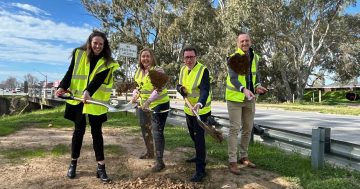
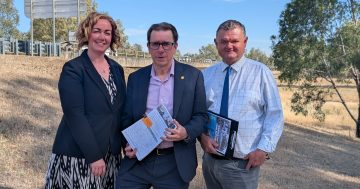
Minister Hoenig with Dr Joe McGirr under the bridge this week. Photo: Supplied.
The long-running campaign to duplicate Wagga Wagga’s Gobba Bridge has gathered fresh momentum, with NSW Local Government Minister Ron Hoenig visiting the landmark crossing and acknowledging the growing need for a second bridge.
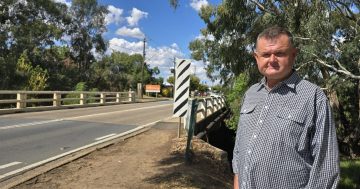
The bridge, which carries Olympic Highway traffic across the Murrumbidgee River and floodplain, is one of the city’s busiest transport links and has become a major bottleneck during peak periods.
Minister Hoenig inspected the site this week after meeting with Wagga MP Dr Joe McGirr, who has been campaigning for the project and recently presented a petition with more than 10,000 signatures to the NSW Parliament calling for the duplication to move forward. The proposal is now set to be debated on the floor of parliament.
“The Gobba Bridge is at capacity or will be very quickly. We have 7000 new homes going into the northern parts of Wagga in the next decade. We need to built the infrastructure to support that to support the growth of our city,” Dr McGirr said.
The Gobba Bridge was opened in the late 1990s as part of the Olympic Highway bypass of Wagga Wagga. Stretching about 1.4 kilometres across the river and floodplain, it is one of Australia’s longest road bridges.
When it was built, the suburbs north of the Murrumbidgee River, including Gobbagombalin, Estella and Boorooma, were still in their infancy. According to the Committee for Wagga, those suburbs had a combined population of about 2000 people at the time.
Today, more than 10,000 people live north of the river, with thousands more expected over the next decade as housing developments continue. The NSW Government has identified land for around 7000 new homes in Wagga’s northern growth areas, placing even greater pressure on the city’s road network.
Unlike many major cities, Wagga has only a handful of river crossings, making the Gobba Bridge a critical link not only for local commuters but also for freight operators travelling along the Olympic Highway between southern and western NSW.

Traffic is often backed up along the Olympic Highway with Gobbagombalin Bridge providing the only crossing from the north. Photo: Chris Roe.
Minister Hoenig said the bridge was a project of statewide importance because of its role in both local transport and the freight network.
“This is probably the largest bridge in Australia. It’s 1.4 km long; it is bigger than the Sydney Harbour Bridge … it also involves the duplication of the Olympic Way all the way to Coolamon Road,” he said.
“It’s not just for the northern suburbs of Wagga, it’s got to be part of an integrated freight transport plan. That’s what the government is now considering because of Dr Joe McGirr’s advocacy.”
Despite the growing support, duplicating the Gobba Bridge remains a major infrastructure project, with many observers cynical about whether it will ever happen.
No cost estimate has been released by the NSW Government and no funding has been committed. As well as building a second 1.4-kilometre bridge, the project would require widening sections of the Olympic Highway and upgrading intersections. Comparing it to similar projects, it could cost hundreds of millions of dollars.
Even if funding were committed in the near future, the project would still need to go through detailed planning, environmental assessments and design work before construction could begin. Large bridge projects of this size typically take several years to complete.
Nevertheless, the minister’s visit is being seen as a positive step for a project that has been on Wagga’s infrastructure wish list for years.