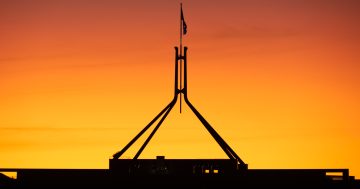
Is it time to fly the flag for Australia? Photo: Michelle Kroll.
The nation is, apparently, going to the dogs.
You can hear this any day of the week on talkback radio, on social media, wherever people have an opportunity to let their opinions loose. I anticipate such opinions appearing in the comments below.
We’ll be lucky to have a country left, the way things are going. Australia is a disaster.
Is it, though?
A colleague often makes the point that, in a troubled world, Canberra is about the safest and best place you can be. Secure employment, physical safety, fresh air, clean water, well-educated, thoughtful neighbours, low crime and no enemies mean we live a life of extraordinary privilege on a global scale – as do most Australians.
This week, I picked up author Andrew Low’s book, We Should be So Lucky. Low is a former investment banker, very much from the top end of town, but he argues many of our founding, egalitarian principles have produced something special – the Australian way.
Low points out that while our GDP is just below the US, our median wealth is more than double theirs and, in fact, the second-highest in the world, behind Luxembourg.
Our health care system is one of the safest and most functional in the world. The Pharmaceutical Benefits Scheme provides us with affordable medication that other countries can only dream of.
We were among the first to introduce universal suffrage and compulsory education; our combination of the pension system and the employer superannuation schemes has evened out retirement for working people, and the minimum wage benchmarks fair remuneration.
We’ve never been invaded or had a civil war. Our democracy was born at the ballot box after long, energetic national debate.
But it’s not just resource-fuelled luck that’s made it so. Low studiously (and perhaps slightly to his detriment) avoids deeper political analysis, but notes conservative and progressive politicians from Deakin to Whitlam have introduced workable, practical policies grounded in the notion of equality.
Now, without doubt, there’s plenty wrong day-to-day. In my role leading Canberra’s community foundation, I witness what happens when lives fall apart. A relationship breakdown, debt, disability and other disasters can all plunge people into dire situations, often not of their own making.
Poverty and distress are very real, as they are elsewhere in Australia, where the top quartile of the population now holds an ever-increasing share of the nation’s wealth. Housing is badly off track after our collective decision to treat it as an investment rather than a basic need.
But are we so naive as to believe we have this on our own? Are we so addicted to whingeing we’d prefer to believe things are much worse than they factually, actually, are? Do we honestly believe anyone else has perfected the business of running a nation?
Take oft-raised suggestions Australia is a high-taxing nation, for example.
Our tax-to-GDP ratio is about 30 per cent compared with an OECD average of around 34 per cent, placing us in the lower third of OECD countries.
We raise a large share of our revenue from personal income tax (second-highest in the OECD), and the top income tax rate is 45 per cent or higher. But unlike the US, UK or Canada, we don’t add social security taxes, and our GST is significantly lower than that of peer nations, at 10 per cent.
There’s a balance to be struck in any economy. You can have abundant services and high taxes (like the Northern Europeans), or low taxes and fewer services.
If you’re in the United States, you can pretend that the size of your economy protects you from the long-term consequences of staggering national debt, currently at around 120 per cent of GDP, or well over $100,000 per citizen. By contrast, our national debt sits at 60 per cent, in the lower-to-middle range among advanced economies.
In Australia, we tend towards the middle in most things. We accept we have to pay for things we want and have designed systems to share our good fortune equitably. They largely work smoothly, predicated on mutual respect.
When Donald Horne wrote The Lucky Country back in 1964, he intended the title satirically. But there’s a good argument this is still the most fortunate place on earth to live.
Perhaps we should reflect that the Australian way, the fair go, is more than good luck. It’s our greatest achievement and well worth celebrating and protecting.
Genevieve Jacobs is the CEO of Hands Across Canberra, the ACT’s community foundation.
Original Article published by Genevieve Jacobs on Region Canberra.