Homing pigeons being released during the 2026 Australian Animal Distinguished Service Awards at the Australian War Memorial. Photo: Australian War Memorial.
They’re usually dismissed as pests – the “rats of the sky” pooing under bridges and pecking at scraps.
But this week at the Australian War Memorial, pigeons were honoured as war heroes.
On the National Day for War Animals, the 13,500-plus birds that carried vital messages during the Second World War in the Southwest Pacific were formally recognised as part of the ‘2026 Australian Animal Distinguished Service Awards’.

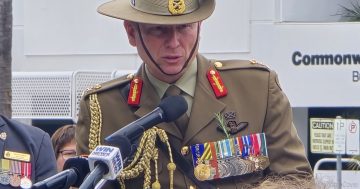
Australian War Memorial director Matt Anderson. Photo: Australian War Memorial.
“Before modern communications, messenger pigeons were a critical and reliable means of relaying information during battle. Many pigeons were injured or killed while carrying messages that helped save lives and influence military outcomes,” Memorial director Matt Anderson said.
“These pigeons played a vital role in Australia’s war history. Presenting this award at last ensures their service to military operations during the Second World War is properly recognised at home, and honours the extraordinary contribution they made.”
Pigeons on the front line
It might be hard to imagine now, but for many of the past century’s wars, the only way to get a message off a battlefield was to strap it to a bird.
Australian National Racing Pigeon Board president Vince Pedavoli (christened unofficially during the awards ceremony “representative of the pigeon world”) says enemy forces were so effective at jamming radio signals that pigeons became essential.
“The only way to actually get messages back from the front was via homing pigeons,” he told Region.
As troops pushed forward, soldiers behind enemy lines would release birds carrying updates for headquarters – detailing troop movements, warning of advancing forces or signalling when to move tanks and reinforcements.
“The fun fact here is that the lofts were actually mobile,” Mr Pedavoli said.
“As the front moved, the mobile lofts would move also. But within 48 hours, the pigeons would know where the mobile loft was, even though it wasn’t in the same location as a couple of days before.”
“They actually just reprogrammed where home was. They have inbuilt GPSs that we still can’t understand.”

Australian National Racing Pigeon Board president Vince Pedavoli speaking at the 2026 Australian Animal Distinguished Service Awards. Photo: Australian War Memorial.
The job was deadly. Enemy troops were ordered to shoot pigeons on sight. Fighter pilots even tried to pick them off mid-air.
“If you see a pigeon, you were under orders to shoot it,” Mr Pedavoli said.
“In fact, there are videos of German fighter pilots trying to shoot down pigeons over the English Channel.”
Without them, he says, the conflict would have unfolded very differently.
“Oh yes, it was going to be totally different.”
The award – and “the animals’ VC”
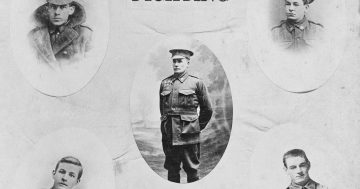
Two Australian carrier pigeons were previously awarded the Dickin Medal – often called “the animals’ VC” – during the Second World War. Their remains are held in the Memorial’s National Collection.
The Dickin Medal was instituted in Britain by Maria Dickin, founder of the People’s Dispensary for Sick Animals, to honour animals displaying conspicuous gallantry and devotion to duty during wartime.

Dickin Medal winner Blue Bar Cock Pigeon No139. Photo: Australian War Memorial.
One of the pigeons, ‘Blue Bar Cock Pigeon No139’, racked up 1615 km over 23 flights, including one vital mission during a severe tropical storm near Madang, New Guinea, on 12 July 1945. Homing 64 km to Madang, it brought a message which enabled a rescue ship to be sent in time to salvage an Australian craft and its valuable stores and ammunition.
The Australian awards are presented by the Australian War Animal Memorial Organisation and serve as a national equivalent to those earlier British honours.
This year’s ceremony also recognised civilian service dog Lachie and posthumously honoured Explosive Detection Dog Flo Joe.
“Holding the awards at the Australian War Memorial deepens our role in recognising service and sacrifice, including the vast contributions of animals to Australia’s military history,” Mr Anderson said.
More than “rats of the sky”
So what about today’s pigeons?
Mr Pedavoli bristles at the idea they’re just grubby birds loitering in city underpasses.
“People call them rats of the sky, but all I say is, you’ve actually got to look at the modern-day racing pigeon compared to what you’re seeing under the bridge, and you’ll soon see the difference,” he said.
“It’d be like a donkey lining up for the Melbourne Cup. They’re totally different animals.”
He describes them as elite endurance athletes.
“These pigeons can fly unassisted, 85 km/h, nonstop, all day, to get home,” he said.
“They will come back to your loft anywhere from 100 kilometres to 1000 kilometres, and in many instances they will do it on the day, nonstop. They are super athletes.”
And in an age of cyber warfare and signal jamming, he’s not ruling out a comeback.

The posthumous award for the 13,500 Australian homing pigeons that served during World War II. Photo: Australian War Memorial.
“You shouldn’t say no, because there may come a day when you’re fighting … and you might still find pigeons are the only way of getting messages back from the front. It wouldn’t surprise me.”
That’s why, he notes, both the French and Chinese military still maintain active flocks – just in case.
“We’re still fascinated by them.”
For now, the birds are honoured with a plaque in the Memorial’s Sculpture Garden.
Original Article published by James Coleman on Region Canberra.