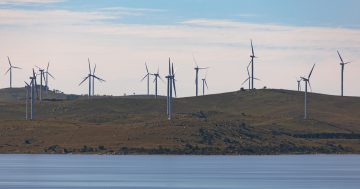
Wind turbines along Lake George. Photo: Michelle Kroll.
There’s nothing to divide a rural community like a wind farm proposal. Unless, of course, it’s a major power line, a huge waste dump, or the now reduced inland rail project.
Across the south-east, we’re in the midst of a major energy and infrastructure transition and transformation.
Much of the burden of that development is felt not by the people in major cities who form the bulk of the population, but by regional Australians. Roads are torn up, tourist accommodation vanishes, local economies experience wild swings, and you can’t get an appointment with your local GP for love nor money.
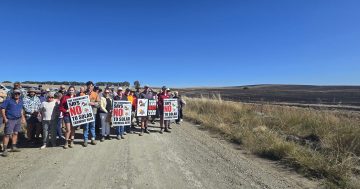
Anger over these projects can tear communities apart. Battle lines are drawn between neighbours whose families go back generations.
But what if there was another way to balance up the energy transition scales?
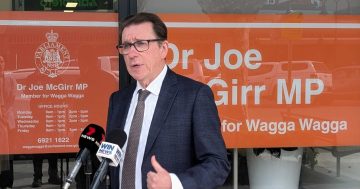
This week I chaired a roundtable at NSW Parliament on community benefits from these major energy and infrastructure schemes, covered by Member for Wagga Dr Joe McGirr and Member for Albury Justin Clancy.
Led by the Community Foundation for the Snowy Valleys and involving landholders, proponents, community foundations and energy groups, local government representatives and a slew of NSW politicians, the forum didn’t ask whether individual projects (or renewable energy) were right or wrong, but rather how to ensure small regional communities have a say, reap the benefits and engage in the long term over projects.
Among them were Crookwell farmer and Upper Lachlan Community Foundation chair Ben Carter who looks out along the valley of the Wollondilly, where his family has farmed for five generations, and sees 48 turbines.
Or Louise Halsey from Tumut, who calls herself a Snowy kid, remembers the immense disruption of the initial scheme – but also the many benefits it brought including to Australian culture. “Ever heard of a cappuccino?” she quips.
They and many others see a fairer, more just, path forwards that potentially ends much of the polarisation.
When I refer to community benefits, I don’t mean payments to individual landholders, or cleaning up after the projects end, or paying for consultation groups at the start. I don’t mean painting the village hall, installing a swing set at the playground or being a reliable donor to local charities.
Rather, this is a call for long-term, intergenerational, meaningful outcomes with local ownership, and benefits that are commensurate with the scale of the transition. It’s a call for investment at scale, generating revenue that becomes an asset for the whole community’s use.
That means, potentially, a helping hand for every local kid who wants to go to uni for decades to come, or enabling a small town to build a health centre and attract a doctor – a resource for social equity, investing in people as well as things.
Some proponents engage deeply, and most have got the message that they need to establish a social licence. But all too often that interaction happens at the beginning of the project, not throughout its life.
Often, it’s proponents driving the outcomes not the community. Councils are sometimes left with assets they didn’t ask for but must fund into the future.
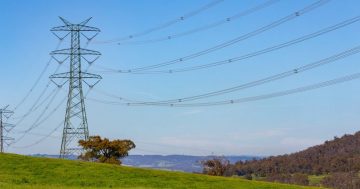
And it’s not as if the cash is limited. At Tumut the massive HumeLink project is worth $4.8 billion. The contested Bendenine project at Bowning has a $1.8 billion price tag.
The NSW Government requires community consultative committees and environmental impact statements for project approval, but most affected communities in south-eastern NSW and areas around the ACT are not even in a renewable energy zone.
The roundtable called for NSW Parliament to inquire into long-term community benefits from major infrastructure development, focusing on significant, intergenerational benefit, genuine local control and consultation, and fair and transparent benefit-sharing.
Wagga MP Dr Joe McGirr introduced an amendment this week into the Energy Legislation Amendment (Prioritising Renewable Energy) Bill 2026, requiring a review of the quality of community engagement and benefits.
“This is an opportunity for us to get this right,” he told parliament. “We cannot leave the issue of community guidelines, and community benefits and consultation, as done and dusted. It is not. It is too important to the wellbeing of our community.”
Amid the brawling, there’s an opportunity to find a middle path towards community consensus. Some projects will be wrong for some communities. Others will proceed, but the transition is with us whether we like it or not.
We can make a major, long-term difference for our regional communities, but it will require both leadership and collaboration.
Genevieve Jacobs is the CEO of Hands Across Canberra, the ACT’s community foundation.
Original Article published by Genevieve Jacobs on Region Canberra.