

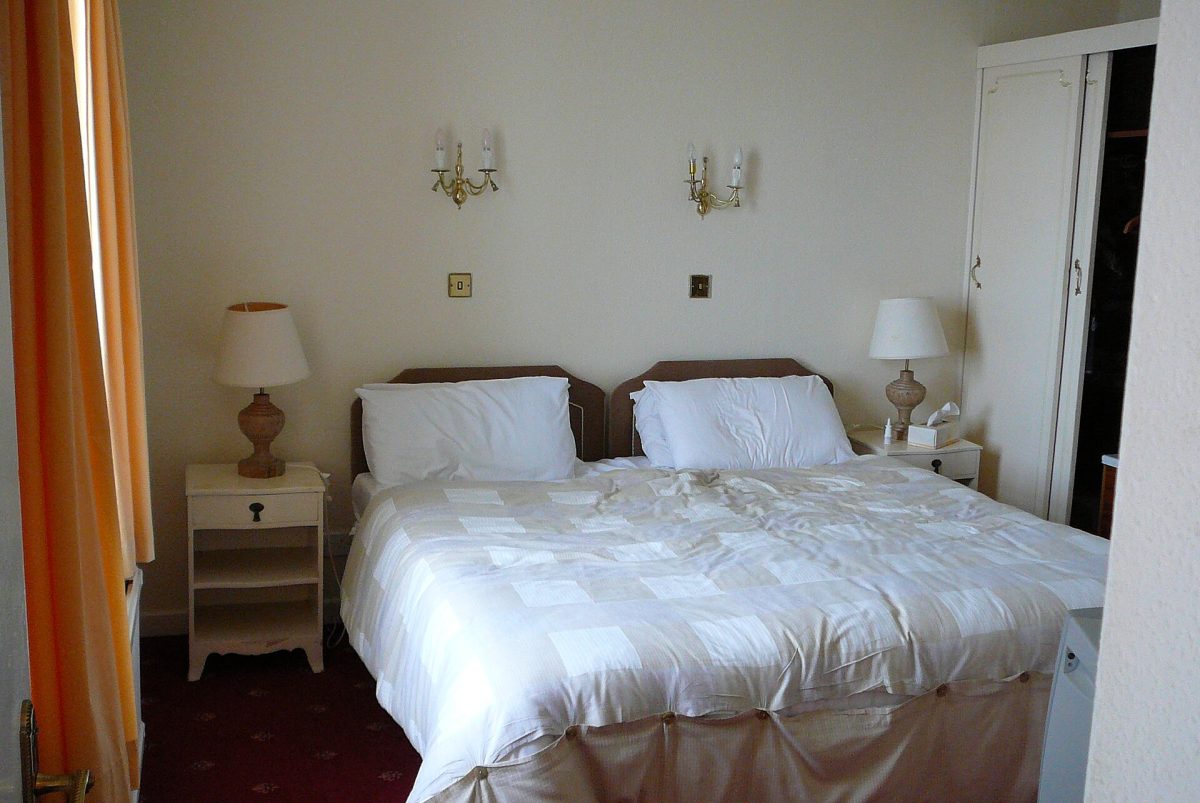
Two hundred dollars a night doesn’t always get you value for money. Photo: Wikimedia Commons.
Anyone who’s taken a domestic holiday this summer will know the feeling: you get home, check your bank account, and quietly wonder whether you’ll ever be able to afford to leave again.
Australia has plenty of excellent hotels, and many operators are doing it tough under heavy regulation, high labour costs and soaring property prices. But when those pressures flow through to higher prices and pared-back service, it’s travellers who end up wearing it.
This is very much a first-world gripe, drawn from nothing more scientific than a recent series of trips – stays where minor frustrations stacked up, making a break feel oddly like work.
Taken together, they boil down to patchy value for money, the Airbnb obstacle course, rigid checkout times, scaled-back service, and the slow creep of extra charges.
Here are five things that have irritated me lately about Australia’s hotel and Airbnb scene.
1. When the price doesn’t quite match the stay
The price of hotels and Airbnbs skyrocketed during COVID, but unlike face masks and Zoom trivia nights, those higher costs never really went away.
Even the South Coast — once the reliable, budget-friendly weekend escape for Canberra families — now struggles to offer a decent-quality cabin for under $200 a night at peak times.
And it’s not just coastal towns. In big cities, that kind of money doesn’t always buy luxury either: it sometimes comes with laminate floors, mismatched crockery and the faint but unmistakable sense that something suspicious happened in the bathroom at some point.
At times, you strike gold. On other occasions, you’re left wondering how the numbers got so high and the standards so … negotiable.
2. Airbnb, now with escape-room elements
When Airbnb first took off, it felt like a revelation: cheaper, homely and flexible. Lately, it has felt like a hotel price without the hotel.
The real joy comes at arrival. Walk to the beige courtyard two buildings to the left. Locate the yellow lockbox behind the pot plant. Enter a six-digit code with a special character. Retrieve the key. Repeat a similar process to park the car and work out how to leave.
Get it wrong and there’s no reception desk — just a sequence of increasingly passive-aggressive automated messages reminding you to “please refer to the instructions”.
And after all that? No service, no flexibility, and no one to complain to except an app.
3. Checkout times that feel like an eviction notice
The last five hotels I’ve stayed at have all required a 10 am checkout. I understand the logistics, but it doesn’t feel like hospitality so much as a polite form of expulsion.
A holiday morning should involve a sleep-in, a relaxed breakfast, maybe a final stroll — then back to the room to pack at a civilised pace. Instead, the last hour of a stay increasingly reminds me of my Marist College Canberra school camps, where we were dragged out of bed, told to get dressed immediately and made to feel vaguely guilty for still being in the room.
Check-in can be just as rigid. I’ve spent more than one afternoon cooling my heels in a hotel foyer, bags piled around me, waiting for the clock to hit 3 pm exactly. Kudos to the hotels that bend the rules — but too often, I’m left staring at a clock like it owes me an apology.
4. Reduced service, now explained as policy
COVID gave hotels a reason to change how services were delivered, and in some cases, those changes have quietly stuck.
At a hotel in the Riverina recently, I asked why my room hadn’t been serviced.
“Oh, we don’t clean unless you specifically ask for it, sir,” I was told.
It used to be a given. Now it’s treated like an optional extra, even as room rates remain firmly fixed.
In smaller towns, limited reception hours can add to the feeling that you’re largely on your own. It’s efficient, but occasionally it gives off strong Woolworths self-checkout energy — except instead of saving money, you’re paying more than ever.
5. The slow accumulation of extra charges
Many Airbnbs now add hefty cleaning fees that dramatically reshape the final price.
Hotels aren’t immune either. Parking at big-city hotels can push $50 a night — an impressive achievement given the car doesn’t even get a pillow.
None of these charges is illegitimate on its own. They just have a habit of piling up, turning what looked reasonable at first glance into something far less so by the time you hit “confirm booking”.
The bottom line
So no, this isn’t an argument that accommodation is broken, or that operators aren’t trying. It’s simply the observation of a traveller who’s had a rough run and noticed the same small irritations cropping up again and again.
Call it a whinge — I probably would. As a journalist whose only truly transferable skill is complaining in complete sentences, I’m well aware I could never do what accommodation operators do.
But if you’ve ever returned from a holiday feeling lighter in the wallet and heavier in frustration, you’ll know exactly what I mean.