

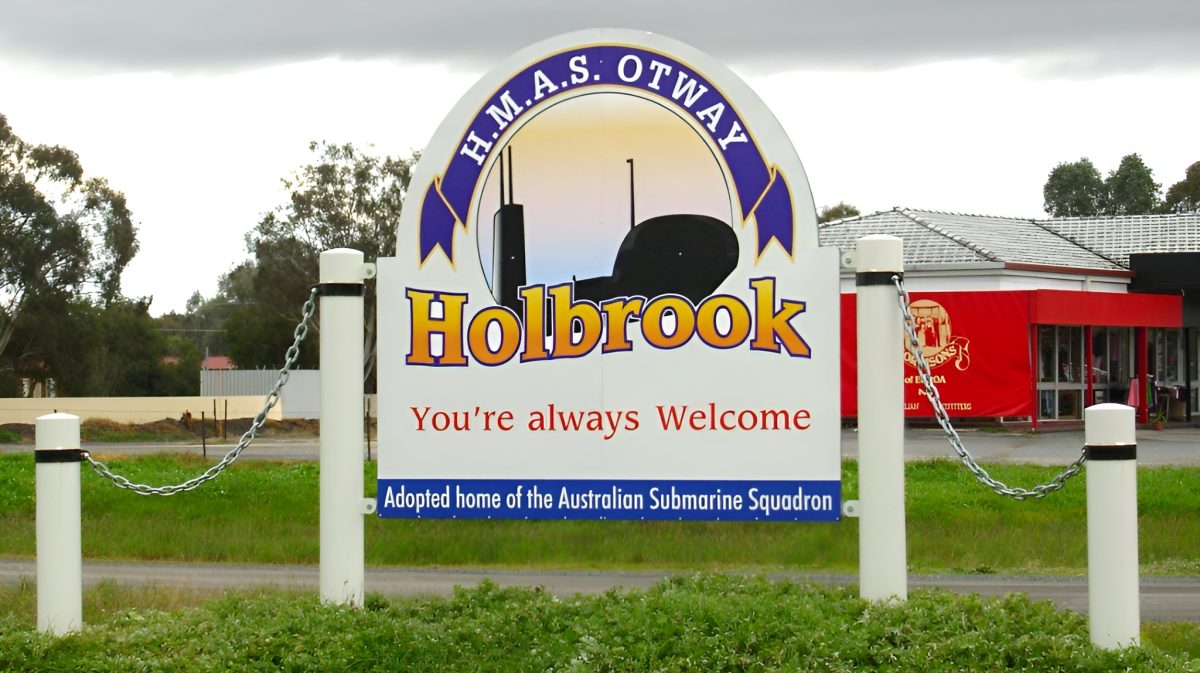
The first drug deal occurred in Holbrook. Photo: Ontheradionetau at English Wikipedia.
A man convicted of organising two large-scale drug deals has failed in his bid to overturn the verdict, despite not being physically present when either exchange took place.
Michael Salafia was found guilty of two counts of supplying a large commercial quantity of a prohibited drug and sentenced to five years in prison. The offences involved encrypted message negotiations about supplying what was believed to be “ice” — a street name for methamphetamine.
According to a published decision of the NSW Court of Criminal Appeal, the first deal began with encrypted messages in 2020 discussing possible meeting spots, including Albury and Gundagai, before Holbrook was ultimately agreed. The second deal was arranged for Goulburn in August 2020.
The Crown case was that Salafia organised both transactions using the encrypted messaging service Ciphr under the handle Don’t Look Twice, corresponding with an undercover police officer identified in court as UCO 662.
In one message, Don’t Look Twice told the officer: “I heard you want to swap one eye for 60 boxes are we right to go?”
Prosecutors said the coded language referred to one kilogram of ice in exchange for 60 boxes of illegal cigarettes.
Although Salafia was not present when fake drugs were handed over for cigarettes, the Crown argued he was the central organiser. In the Holbrook exchange, two of his associates met the undercover cop on Bardwell Street and handed over a white crystalline substance that later proved not to be methamphetamine, with police supplying cigarettes as part of the controlled operation.
At trial, Salafia denied sending the Ciphr messages and argued there was no direct evidence linking him to the account or the arrangements. The Crown, however, pointed to a series of messages during which the sender complained of needing hospital treatment after an associate had bitten his finger — providing a timeline that closely matched Salafia’s own hospital records.
A jury accepted the prosecution case and convicted him.
On appeal, Salafia argued the verdicts were unreasonable and that the evidence was insufficient to prove he sent the messages or organised the deals. The Court of Criminal Appeal rejected this, finding that the evidence “was sufficient in nature and quality to eliminate any reasonable doubt that [Salafia] was guilty of the offences for which he was convicted”.
The appeal was dismissed and the conviction was upheld.







The same councilors voted against my complying DA. Scott Grote, Anne Napoli, Mark Dal Bon and… View